Labour Card
What is a Labour Card?
A Labour Card in the UAE also known as a work permit is an official document issued by the Ministry of Human Resources and Emiratisation (MOHRE) that confirms an employee’s legal employment status in the private sector. It serves as proof that an individual is authorised to work in the UAE for a specific employer and under approved employment terms.
The labour card links the employee’s employment contract, and employer sponsorship in MOHRE’s system.
While physical labour cards are no longer commonly issued, the concept remains critical, as labour card details now exist in digital form and continue to play a central role in employment compliance, inspections, and labour dispute resolution.
Types of Work Permits in the UAE
-
Work Permit to Recruit a Worker from Outside the UAE
Issued to employers seeking to hire a non-UAE national from outside the country, subject to specific regulatory conditions and approvals. This permit is typically valid for two years. -
Work Permit to Transfer a Non-UAE Worker Between Establishments
Allows the transfer of an expatriate employee from one UAE-based employer to another. This work permit is valid for two years. -
Work Permit for Residents Under Family Sponsorship
Enables employers to hire individuals who reside in the UAE under family sponsorship. The permit allows lawful employment and is valid for two years. -
Temporary Work Permit
Permits an establishment to assign an employee who is already in the UAE to perform specific tasks for a different employer for a limited period. Upon completion, the employee returns to their original employer. -
Mission Work Permit
Allows employers to bring a worker from outside the UAE to carry out a specific, time-bound task or project. This permit is intended for short-term assignments. -
Part-Time Work Permit
Enables employers to engage workers under a part-time arrangement, whether the individual is inside or outside the UAE. Working hours or days are fewer than those of a full-time role. With MOHRE approval, an individual may work for more than one employer under this permit. -
Juvenile Work Permit
Allows establishments to employ individuals aged 15 to 18 years, subject to strict conditions that ensure a safe and suitable working environment. This permit is valid for one year. -
Student Training and Employment Permit
Enables organisations to employ or train students aged 15 years and above who are already residing in the UAE. Employment is subject to specific safeguards, and the permit is valid for three months. -
UAE and GCC National Work Permit
Issued to employers wishing to hire UAE nationals or GCC citizens. This work permit is valid for two years. -
Golden Visa Holder Work Permit
Granted to employers seeking to hire individuals residing in the UAE under a Golden Residency Visa. The permit is valid for two years. -
National Trainee Work Permit
Issued to MOHRE-registered establishments to train UAE nationals in line with their approved academic qualifications. This permit is valid for 12 months and may be renewed upon mutual agreement. -
Freelance Work Permit
Issued to individuals who wish to work independently as freelancers without being sponsored by a UAE employer. This includes foreign nationals on self-sponsored residence visas. Freelancers provide services for a defined period or project without being considered employees of the client entities. -
Private Teacher Work Permit
Allows individuals to legally provide private teaching services in the UAE, subject toregulatory approvals and conditions set by the relevant authorities.
Purpose of a Labour Card
The labour card exists to ensure:
-
Legal employment and workforce regulation
-
Compliance with UAE Labour Law
-
Protection of employee rights
-
Oversight of employer obligations
For HR teams, the labour card is a core compliance element that validates the employment relationship and supports lawful workforce management.
Who Requires a Labour Card?
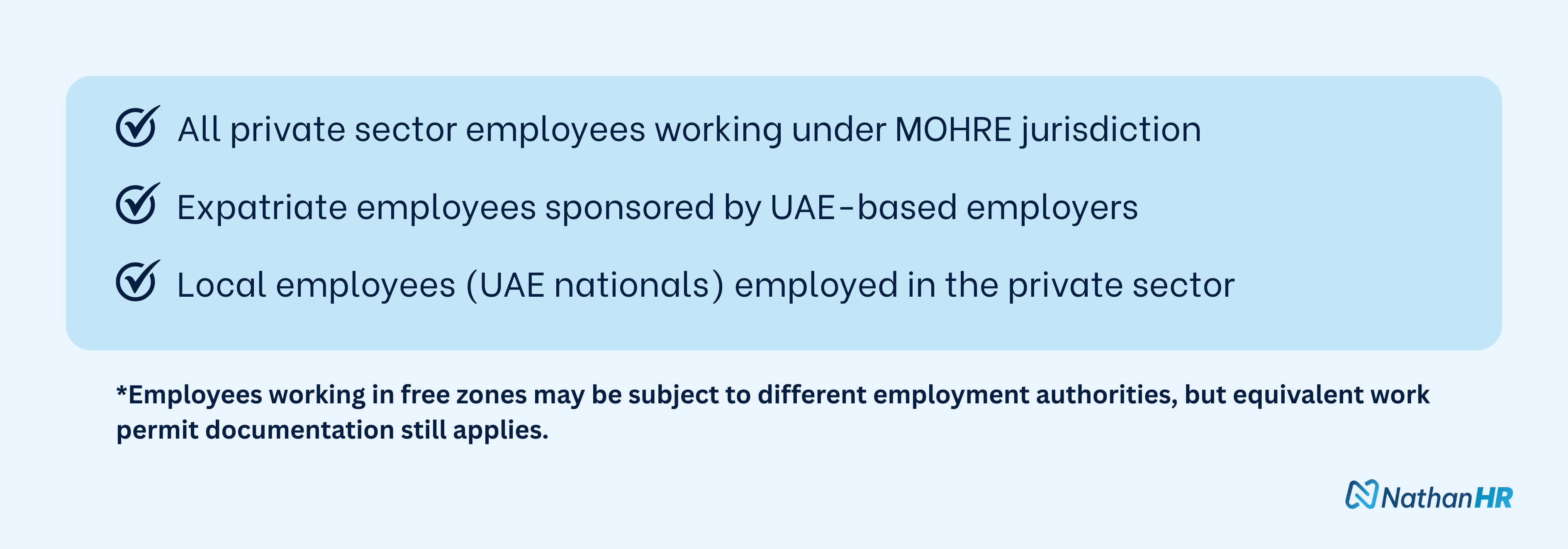
A labour card is required for:
Key Information Included in a Labour Card
A labour card typically contains the following information (digitally recorded by MOHRE):
-
Employee name and nationality
-
Job title and occupation code
-
Employer name and licence details
-
Labour card number
-
Work permit status and validity
-
Contract type (fixed-term)
-
Employment start and end dates
This information must match the employee’s registered employment contract. Any discrepancy may lead to compliance issues.
Issuance of a Labour Card
Application Process
The employer is responsible for applying for the labour card through MOHRE once:
-
A valid employment contract is signed
-
The employee has completed medical tests and residency formalities
Validity
-
Labour cards are issued for the same duration as the employment contract
-
Typically valid for up to two or three years, depending on contract terms
Renewal
Labour cards must be renewed when:
-
The employment contract is renewed
-
Any material change occurs in employment terms
Failure to renew on time may result in fines or operational delays.
Changes and Amendments to a Labour Card
Any change in employment terms must be reflected in MOHRE’s system, including:
-
Job title changes
-
Salary adjustments
-
Contract renewals
-
Employer transfers
HR teams must ensure amendments are submitted promptly to avoid discrepancies during audits or inspections.
Cancellation of a Labour Card
A labour card must be cancelled when:
-
Employment is terminated
-
The employee resigns
-
The employee transfers to another employer
Importance of Labour Cards for HR and Employers
Legal Compliance
A valid labour card confirms that the employee is legally employed and protected under UAE Labour Law.
Workforce Governance
Labour cards help authorities track employment trends, Emiratisation compliance, and sector-specific workforce data.
Dispute Resolution
In labour disputes, MOHRE relies on labour card records to verify employment terms, duration, and employer responsibility.
Inspections and Audits
During inspections, employers must demonstrate valid labour cards for all employees.
Common Issues and Risks
-
Employing staff without a valid labour card
-
Mismatched contract and labour card details
-
Delayed renewals or cancellations
-
Incorrect job classifications
These issues can result in fines, legal disputes, or restrictions on future hiring.
Best Practices for Managing Labour Cards
-
Maintain Accurate Records
Track labour card numbers, validity dates, and linked contracts. -
Align Contracts and MOHRE Records
Ensure all employment contracts match labour card details. -
Monitor Expiry Dates
Proactively renew labour cards and work permits before expiry. -
Educate Employees
Inform employees about the purpose of the labour card and their rights. -
Use Digital HR Systems
Automate tracking and compliance reporting to reduce risk.
Labour Cards and Modern UAE Employment Practices
Although the labour card is now digital, it remains a cornerstone of UAE employment compliance. Its integration with work permits, contracts, visas, and payroll systems ensures transparency, accountability, and legal protection.
For HR professionals, understanding labour cards is essential to:
-
Managing expatriate and local workforces
-
Ensuring lawful hiring and termination
-
Supporting audits and regulatory reviews
-
Maintaining organisational credibility
Conclusion
The Labour Card is a fundamental element of employment compliance in the UAE. It validates an employee’s legal status, links employment contracts to regulatory systems, and safeguards both employer and employee rights.
While the process has become digital, the importance of accurate labour card management remains unchanged.
For organisations operating in the UAE, effective labour card administration is not just a regulatory requirement, it is a key component of responsible, compliant, and sustainable workforce management.