Limited vs Unlimited Contracts in the UAE
Employment contracts define the legal relationship between an employer and an employee, outlining rights, obligations, and conditions of employment.
Historically, the UAE recognized two main types of contracts: Limited Contracts and Unlimited Contracts.
These contract types governed how long an employment relationship could last, how it could be terminated, and the employee’s entitlement to notice periods and end-of-service benefits.
With the introduction of Federal Decree Law No. 33 of 2021, the UAE significantly reformed its labour framework. Under the current law, all employment contracts must now be fixed-term (limited).
However, the concepts of limited and unlimited contracts remain highly relevant in HR practice, as many employees were previously hired under unlimited contracts, and their rights continue to be protected during the transition period.
Understanding the distinction between limited and unlimited contracts is essential for HR professionals, employers, and employees, as it affects termination rules, notice periods, gratuity calculations, workforce planning, and legal compliance.
Limited Contract (Fixed-Term Contract)
A Limited Contract, also known as a Fixed-Term Contract, is an employment agreement that is valid for a specific duration often the duration of a person's UAE residency visa, clearly stated in the contract. Under current UAE labour law, all employment contracts must be limited contracts with a maximum duration of three years, renewable upon mutual agreement.
Key Characteristics of Limited Contracts
-
The contract has a defined start and end date.
-
The employment relationship automatically ends upon contract expiry unless renewed.
-
Either party may terminate the contract early, subject to legal conditions and notice requirements.
-
Renewal terms must be agreed upon before the contract expires.
Limited contracts are now the standard and mandatory contract type in the UAE, applicable across industries and employment categories.
Unlimited Contract (Open-Ended Contract)
An Unlimited Contract is an employment agreement without a fixed end date. It allowed either the employer or employee to terminate the contract at any time, provided the contractual notice period was served and the termination was lawful.
Unlimited contracts were widely used in the UAE before the introduction of the new labour law but are no longer issued. Existing unlimited contracts were required to be converted into limited contracts within the transition period specified by law.
Current Legal Status
-
Unlimited contracts are no longer valid for new employment relationships.
-
Employees previously hired under unlimited contracts retain their accrued rights.
-
Employers were required to transition all employees to limited contracts in line with the updated legislation.
Key Differences Between Limited and Unlimited Contracts
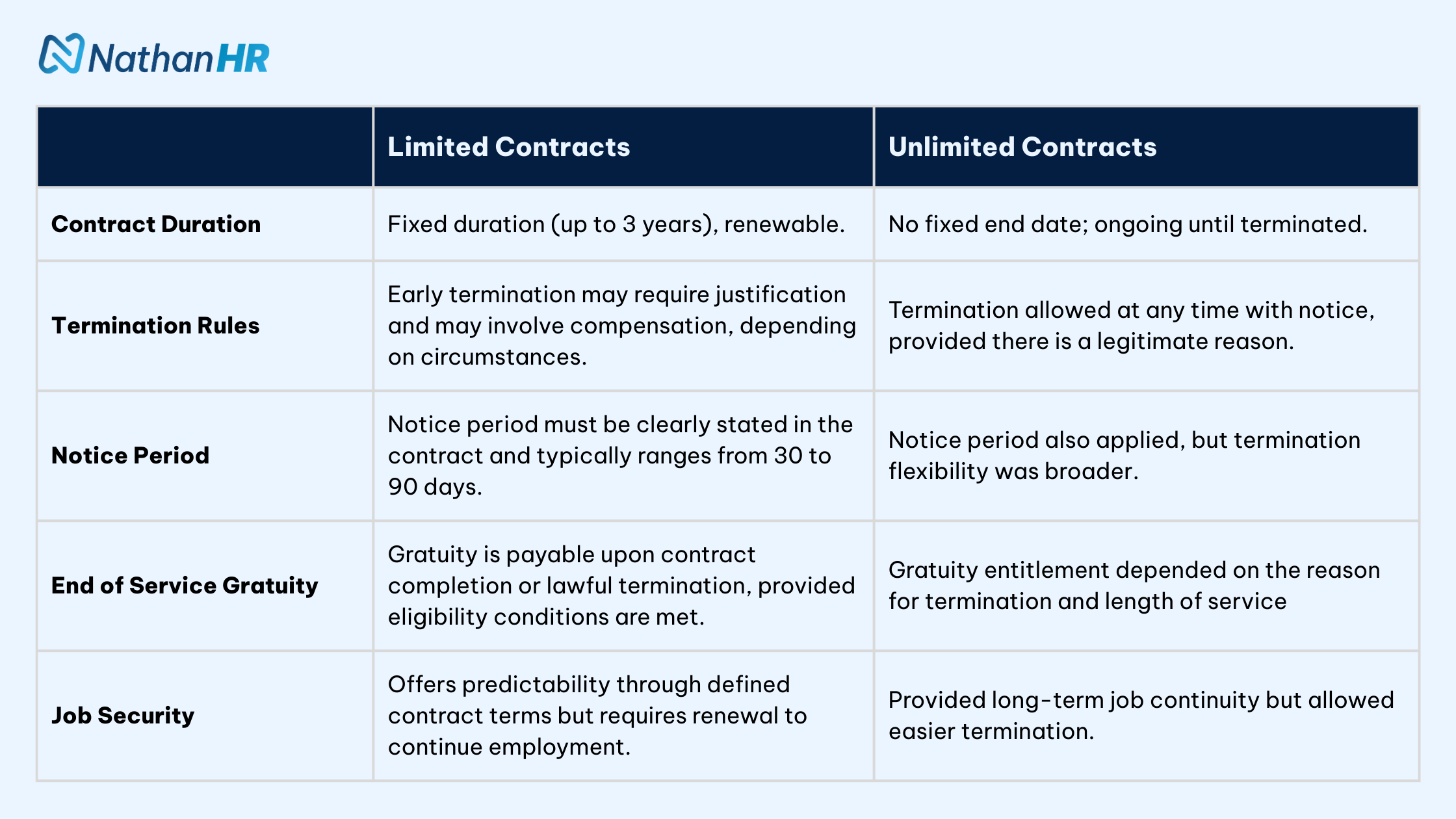
Termination Under Limited Contracts
Under the current UAE Labour Law, limited contracts may be terminated before expiry in the following situations:
-
Mutual agreement between employer and employee
-
Notice-based termination, provided contractual and legal requirements are met
-
Employer-initiated termination for legitimate business or disciplinary reasons
-
Employee resignation, subject to notice and compliance with contractual obligations
Failure to follow proper termination procedures may expose either party to compensation claims or legal disputes.
Impact on End of Service Benefits
One of the most significant HR considerations when comparing limited and unlimited contracts is the calculation of End of Service Gratuity:
-
Under the updated framework, gratuity entitlements are now more standardised, regardless of whether the employee resigns or is terminated.
-
Employees are generally entitled to gratuity after completing one year of continuous service, subject to lawful termination.
-
The shift to limited contracts has reduced ambiguity and improved fairness in gratuity calculations.
HR teams must ensure gratuity policies are aligned with the latest legal requirements and clearly communicated to employees.
HR and Compliance Implications
Workforce Planning
Limited contracts enable employers to align employment terms with business cycles, project timelines, and operational needs. However, they require proactive planning to manage renewals, succession, and talent retention.
Contract Management
HR teams must track contract expiry dates, renewal timelines, and notice periods to avoid unintended contract lapses or compliance issues.
Employee Communication
Clear communication around contract type, duration, and renewal expectations is critical to avoid misunderstandings and disputes.
Legal Compliance
Failure to comply with contract regulations may result in penalties, disputes, or reputational damage. Employers must ensure all contracts are registered correctly and reflect current labour law requirements.
Common Challenges
-
Transition Confusion: Employees previously on unlimited contracts may misunderstand their rights under limited contracts.
-
Renewal Oversight: Missed renewal deadlines can disrupt operations or result in legal exposure.
-
Termination Disputes: Poorly documented termination decisions may lead to labour complaints.
-
Policy Alignment: Internal HR policies may still reflect outdated unlimited contract terminology.
Best Practices for Employers and HR Teams
Standardise Contract Templates
Ensure all employment contracts reflect current legal requirements and clearly define duration, notice, and termination terms.
Track Contract Lifecycles
Use HR systems to monitor contract start dates, expiry dates, and renewal deadlines.
Educate Employees
Clearly explain what limited contracts mean, how renewals work, and how termination and gratuity are handled.
Align Policies and Procedures
Update HR handbooks, onboarding materials, and internal policies to reflect the fixed-term contract framework.
Seek Legal Guidance When Needed
For complex terminations or disputes, ensure decisions are supported by legal or HR expertise.
Strategic Impact
The shift from unlimited to limited contracts represents a significant evolution in the UAE’s employment landscape.
While limited contracts provide clarity, structure, and regulatory consistency, they also require stronger HR governance, proactive workforce planning, and clear communication.
Organizations that manage limited contracts effectively benefit from improved compliance, reduced disputes, and more strategic control over talent management.
For employees, the updated framework offers greater transparency and standardisation of employment rights.
Conclusion
Limited and Unlimited Contracts play a critical role in understanding employment relationships in the UAE. While unlimited contracts are now largely a legacy concept, their implications remain relevant for historical employment arrangements.
Today, limited (fixed-term) contracts form the legal foundation of all employment in the UAE, shaping termination rules, gratuity entitlements, and workforce planning strategies.
For HR professionals, mastering the distinctions and practical application of these contract types is essential to ensuring compliance, protecting employee rights, and supporting sustainable organizational growth.