GCC Labour Mobility
What Is GCC Labour Mobility?
Labour mobility refers to the ability of workers to move freely between jobs, employers, or countries.
In the GCC (Gulf Cooperation Council) context, it specifically relates to the movement of talent between the six member states:
- United Arab Emirates (UAE)
- Saudi Arabia (KSA)
- Qatar
- Bahrain
- Kuwait
- Oman
In simple terms: GCC labour mobility is about making it easier for professionals especially citizens and skilled expatriates, to work across the Gulf region with fewer legal or logistical barriers.
Why GCC Labour Mobility Matters
The GCC region has long depended on foreign talent to power its industries from oil and construction to finance, tech, and tourism.
As the region diversifies its economies under visions like UAE Vision 2031 and Saudi Vision 2030, attracting and retaining the right talent across borders is key.
Labour mobility helps:
- Employers fill roles faster across GCC markets
- Employees access wider career opportunities
- Governments create more efficient, competitive labour markets
- Regional integration and economic alignment across the GCC
Types of Labour Mobility in the GCC
1. Intra-GCC National Mobility (for GCC citizens)
- Citizens of GCC countries can work in any member state without a work permit.
- They receive equal treatment in salaries, pensions, and benefits under unified GCC regulations.
2. Expatriate Labour Mobility
- Expatriates moving between GCC countries must follow individual visa and employment laws of each country.
- Recent reforms aim to standardize, ease, and digitalize mobility for skilled foreign professionals.
3. Sector-Based and Skills-Based Mobility
- Regional plans increasingly support mobility based on skills, qualifications, and industry needs, especially in healthcare, IT, engineering, and education.
Recent Reforms & Initiatives Supporting GCC Labour Mobility
Unified Employment System (GCC e-link)
The GCC is working on digitally connecting labour databases to simplify hiring, background checks, and approvals across borders.
Mutual Recognition of Qualifications
Professionals (e.g., doctors, engineers, accountants) can increasingly transfer credentials between GCC countries without full re-certification.
Standard Contracts and Benefits
Efforts are underway to harmonize labour standards, contracts, and protections, making it easier to move between employers regionally.
Portable Social Security & Pensions (for GCC nationals)
GCC nationals can retain pension rights even if they work in a different Gulf country.
What This Means for Employers and HR in the UAE
If you’re hiring in the UAE or expanding across the GCC labour mobility offers clear benefits:
- Faster Hiring Across Borders
Tap into regional talent without starting from scratch in each country.
- Easier Relocation of Existing Employees
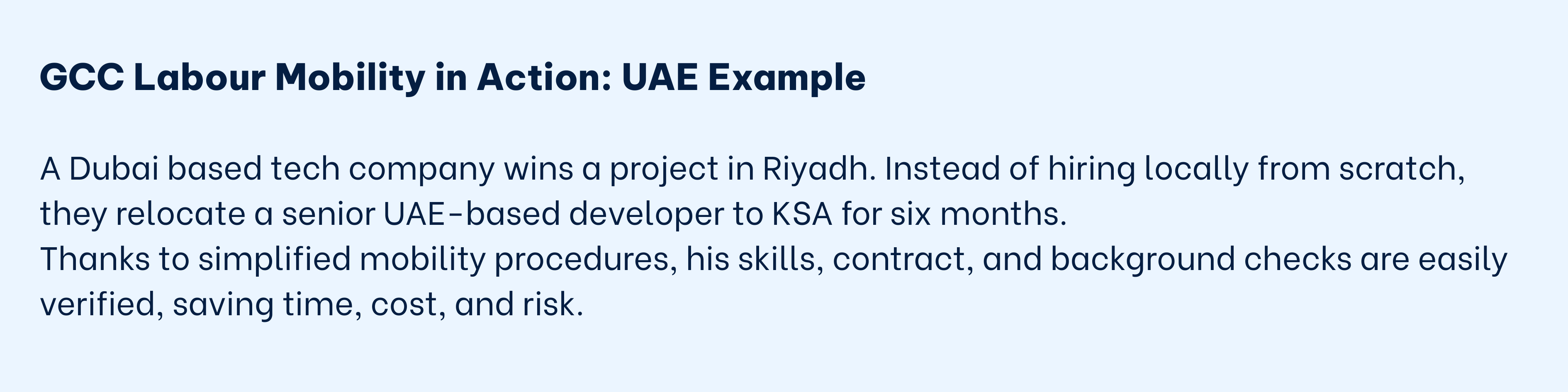
Transfer staff to new offices or projects in KSA, Qatar, or Oman with fewer administrative hurdles.
- Broader Talent Pools
Access highly skilled professionals from across the Gulf without needing complex international relocation.
- Competitive Advantage
Employers offering regional growth opportunities attract top talent.
Challenges to Watch Out For
While GCC labour mobility is improving, HR professionals should still navigate:
.png)
How Companies Can Prepare for GCC Labour Mobility
To leverage regional mobility, companies should:
- Develop GCC-wide HR strategies
- Work with legal advisors to harmonize contracts across borders
- Use Employer of Record (EOR) services for faster market entry
- Keep updated with labour reforms and mutual agreements
- Invest in digital HR systems that track cross-border employees and documents
Final Thoughts
As the GCC region grows more connected, labour mobility is becoming a game-changer not just for governments, but for businesses and professionals looking to grow across borders.
For UAE-based HR teams and employers, understanding and leveraging labour mobility can unlock regional talent, reduce hiring friction, and support long-term expansion
FAQs About GCC Labour Mobility
1Can a GCC citizen work in another Gulf country without a visa?
Yes. GCC citizens can work in other member states without a work visa and are entitled to equal employment rights.
Can expats move between GCC countries easily?
It’s improving, especially for skilled professionals, but expats still require new work visas and approvals in each country.
Are pensions transferable across GCC states?
For GCC citizens, yes. A unified system supports pension portability. For expats, gratuity laws apply per country.
Will my employment contract be valid in another GCC country?
No. Each country requires locally compliant contracts, though the terms can be aligned under your company’s GCC-wide policy.
How can employers stay compliant?
Use updated contract templates, consult with local HR/legal experts, and explore regional HR outsourcing or EOR services.