.png&w=3840&q=75)
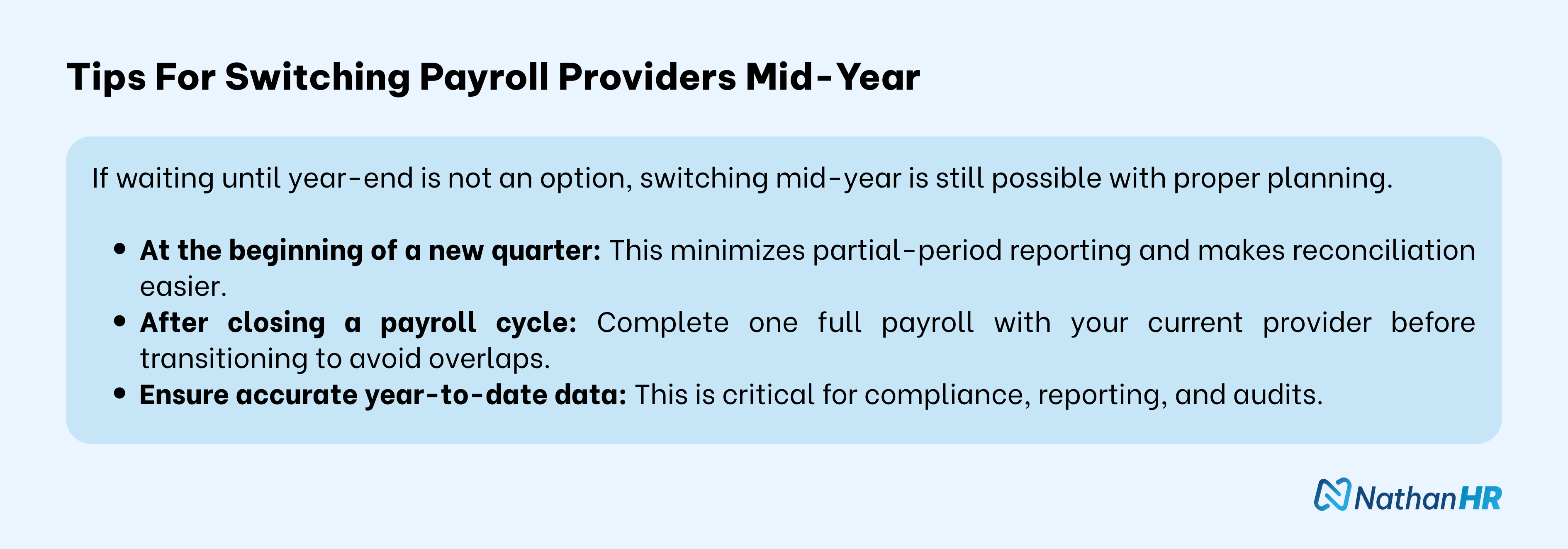
Switching payroll providers is often driven by business growth and increasing complexity, when an existing provider can no longer keep pace with scaling teams, system integrations, and compliance requirements. When switching, be sure to assess the new provider, run tests, properly close accounts with your current provider, and communicate the changes to your employees. It’s also best to make the change at the beginning of a new year.
Payroll is one of those business functions that often only gets attention when something goes wrong. Salaries paid late, compliance questions, confusing reports, or systems that simply cannot keep up with business growth can quickly erode employee trust and management confidence.
In the UAE, payroll is more than just paying salaries. It is closely tied to compliance with MOHRE regulations, the Wage Protection System (WPS), tax considerations, and increasingly, integration with HR and finance systems.
Choosing the right payroll provider and knowing when to change one can make a significant difference to how smoothly your business operates.
At Nathan HR, we deliver payroll services enabled by deep local expertise and smart technology. This combination allows organizations to stay compliant, improve accuracy, and gain clear visibility over their payroll processes, even as they grow and evolve.
Switching payroll providers may feel complex, but with the right planning and the right partner, it can be a structured and low-risk process. This guide walks you through when and why to switch, how to choose the right provider, what the transition involves, and how to avoid common pitfalls.
Why You Should Switch Payroll Providers
Organizations typically do not switch payroll providers without good reason. Below are some of the most common and valid triggers.
Scaling Fast and Your Payroll Provider Cannot Keep Up
As businesses grow, payroll becomes more complex. New hires, multiple pay structures, allowances, overtime, commissions, and multiple bank files all add pressure.
A provider that worked well for a team of 20 may struggle when you reach 100 or more employees, especially across multiple departments or locations.
If payroll processing is becoming slower, more manual, or increasingly error-prone, it is often a sign that your provider or system is no longer fit for purpose.
Poor Integration with Existing Systems
Payroll does not operate in isolation. It needs to work seamlessly with HR systems, time and attendance tools, accounting software, and banking platforms.
When systems do not integrate properly, teams rely on manual uploads, spreadsheets, and duplicate data entry, increasing the risk of errors and delays.
A modern payroll provider should support integration or at least offer structured, reliable data exchange.
Compliance Concerns
UAE payroll compliance is non-negotiable. Issues with WPS file submissions, MOHRE requirements, incorrect salary structures, or missed deadlines can expose businesses to fines and reputational risk.
If your current provider struggles to keep up with regulatory changes or cannot clearly explain compliance requirements, it may be time to reconsider the partnership.
Non User-Friendly Payroll Systems
Payroll systems should support your team, not slow them down. Complicated interfaces, limited reporting, and unclear workflows often lead to dependency on external support for basic tasks.
When HR or finance teams avoid using the system because it is too complex, efficiency suffers.
Increased Errors and Delays
Repeated payroll errors, late salary payments, incorrect deductions, or last-minute corrections undermine employee confidence. Even small mistakes can have a significant impact on morale and trust.
Consistent errors are a strong indicator that a change is needed.
Pricing That No Longer Makes Sense
As your organization evolves, your payroll needs change. Some providers become expensive once headcount grows or when additional services are required.
Others may charge for support, reports, or changes that should be standard.
If costs are increasing without a clear improvement in value, it is worth reviewing alternatives.
Poor Service and Support
Payroll requires timely, knowledgeable support. Delayed responses, unclear guidance, or lack of proactive communication can make payroll cycles stressful.
A payroll provider should feel like a partner, not a bottleneck.
When Is the Best Time to Switch Payroll Providers?
Timing plays an important role in ensuring a smooth transition.
At the Beginning of a New Year
The start of a new financial or calendar year is often the cleanest time to switch payroll providers. Year-to-date figures reset, reporting is simpler, and historical data can be archived more easily.
How to Choose a New Payroll Provider
Selecting the right provider requires more than comparing prices.
Review Your Current Payroll
Start by understanding what is and is not working today. Identify recurring issues, system limitations, reporting gaps, and support challenges. This clarity will guide your selection process.
Evaluate Your Needs
Consider your current and future requirements, including:
Number of employees and expected growth
Pay structures and allowances
Compliance and reporting needs
Integration with HR and finance systems
Level of support required
Compile a List of Potential Providers
Research providers with proven experience in the UAE market. Industry expertise, local compliance knowledge, and scalability should be non-negotiable.
Conduct Due Diligence
Before making a decision:
Review client testimonials and case studies
Request system demonstrations
Understand the full scope of services
Ask about onboarding support and timelines
Explore trial access where available
Closing the Account with Your Previous Provider
Ending the relationship professionally helps ensure cooperation during the transition.
Tips for a smooth exit:
Review contract terms, notice periods, and data ownership clauses
Request all payroll records and reports in advance
Maintain access until the transition is fully completed
Share Required Information
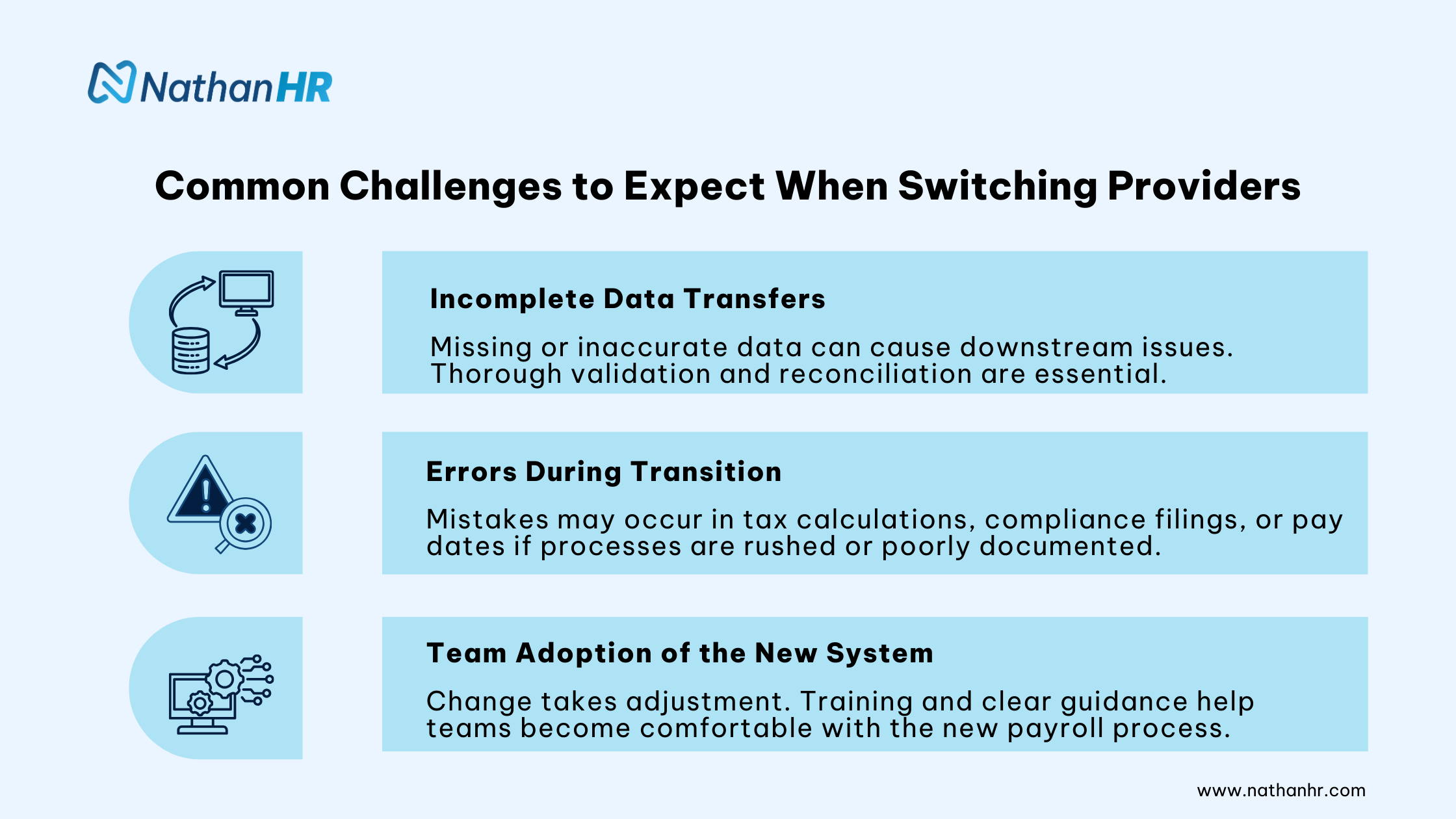
Provide accurate and complete employee data, including salary structures, allowances, deductions, leave balances, bank details, and year-to-date figures. Ensure all historical data is reconciled and verified, as clean and accurate data is critical for a smooth transition and compliance with UAE payroll regulations.
Payroll Shadow Run
A shadow run involves processing payroll with the new provider in parallel with the old one. This allows discrepancies in calculations, tax deductions, WPS files, and compliance reports to be identified and corrected before going live. It helps build confidence that the new system will function accurately from day one.
Finalize Setup
Once accuracy is confirmed, finalize all system configurations, approval workflows, access controls, and integration points with HR and finance systems. Ensure that any automated reports, notifications, and payroll schedules are fully operational.
Announce the Change to Your Team
Clear and transparent communication builds trust and confidence. Inform employees about the change, explain what remains the same, outline any new processes, and provide contact points for questions or issues. Proper communication ensures employees feel informed and reduces confusion during the transition
What to Do After Switching Payroll Providers
The work does not end once the new payroll provider goes live. The post-transition period is critical to ensure accuracy, stability, and long-term success.
Closely monitor the first three to six payroll cycles.
Review salary calculations, allowances, deductions, overtime, leave balances, and final net pay to confirm they align with expectations and contractual terms. Even small discrepancies should be flagged and addressed immediately.
Validate compliance and statutory reporting.
Ensure WPS files are submitted correctly and on time, MOHRE requirements are met, and any applicable statutory filings are accurate. This step is essential to avoid penalties and maintain regulatory confidence.
Review payroll reports and outputs.
Confirm that reports provided meet the needs of HR, finance, and management. Check for clarity, accuracy, and usability, including headcount reports, cost summaries, and variance reports.
Gather feedback from internal teams.
Speak with HR, finance, and line managers to understand how the new system is performing in real workflows. Identify what is working well and where additional support or adjustments may be needed.
Assess service quality and responsiveness.
Monitor response times, issue resolution, and the provider’s ability to proactively support your team. A reliable payroll partner should offer guidance, not just processing.
Document lessons learned and optimize processes.
Use insights from the early months to refine approval workflows, data submission timelines, and internal responsibilities. Continuous improvement ensures payroll remains efficient as your organization evolves.
Regular reviews help turn a successful payroll transition into a long-term operational advantage.
.png)
Conclusion
Switching payroll providers in the UAE is more than a system change, it is an opportunity to strengthen compliance, improve accuracy, and create a smoother experience for both employees and internal teams. When payroll runs efficiently in the background, organizations can focus on growth, planning, and people strategy with greater confidence.
The key to a successful transition lies in preparation, timing, and choosing a provider with proven local expertise and the right technology to support your operations. With a structured approach and clear communication, even complex payroll environments can transition seamlessly.
Ultimately, the right payroll partner should not only process salaries, but also provide clarity, reliability, and peace of mind as your business evolves.

.png&w=3840&q=75)

.png&w=3840&q=75)