Overtime Pay
What is Overtime Pay?
Overtime pay is the additional compensation employees receive for working beyond their standard contractual or legally mandated working hours in the UAE.
It ensures fair remuneration for extra work, aligns with UAE labour law requirements, and protects both employers and employees from disputes over unpaid or miscalculated hours.
Legal Basis for Overtime Pay
Overtime pay in the UAE is governed by Federal Decree Law No. (33) of 2021 on the Regulation of Labour Relations and MOHRE guidelines. Key points include:
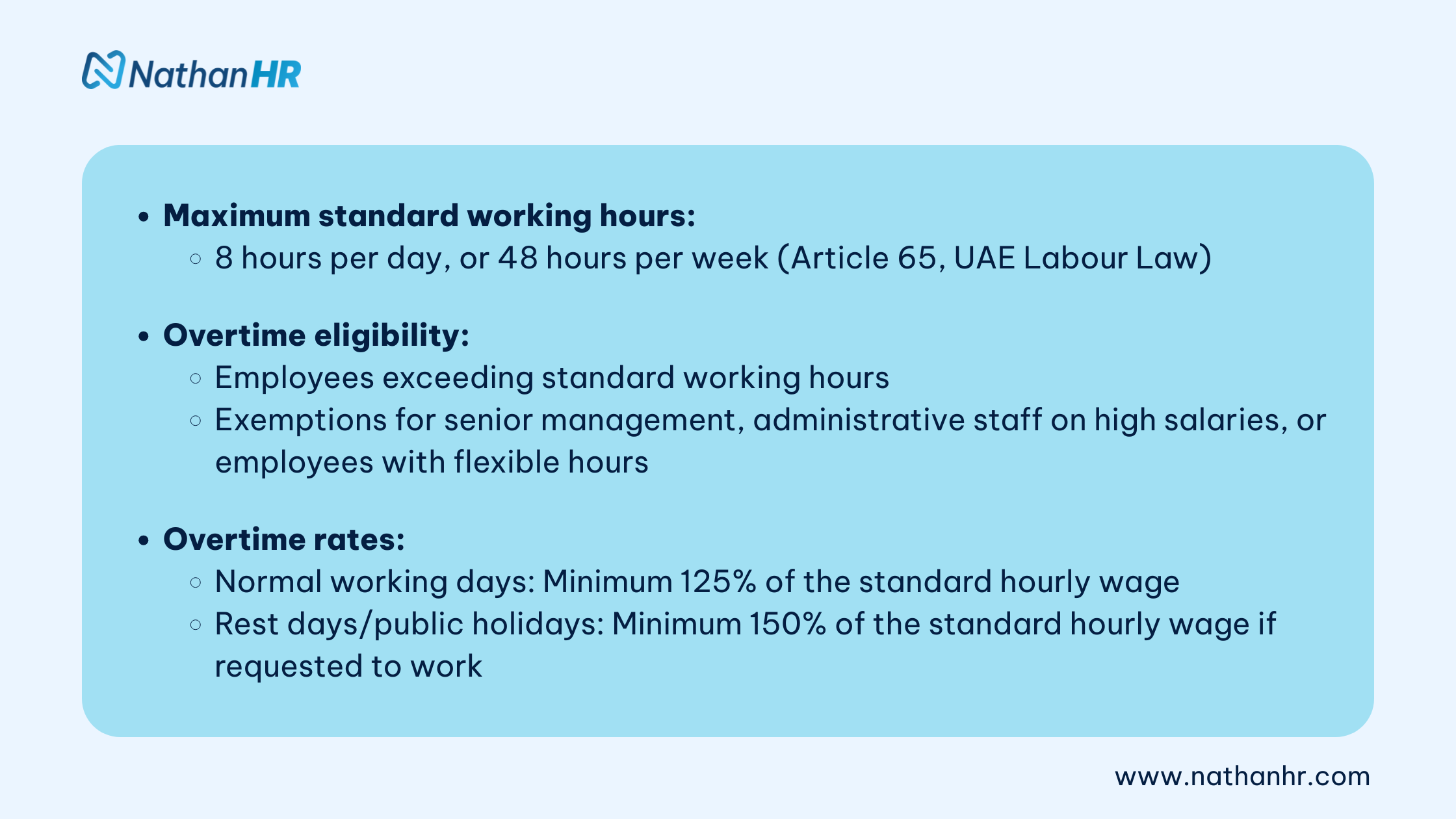
Overtime rules apply regardless of employment type, but specific conditions may differ for part-time, temporary, or contract-based employees.
Who is Eligible for Overtime Pay?
Overtime pay typically applies to:
-
Full-time employees in standard roles
-
Skilled and non-managerial employees
-
Employees whose contracts do not include a fixed all-inclusive allowance covering overtime
Exemptions include:
-
Senior executives and managers whose contracts specify flexible working hours
-
Employees in high-salary bands where overtime is contractually waived
-
Certain part-time or casual roles, depending on contractual arrangements
Employers must clarify eligibility in employment contracts to avoid disputes.
How Overtime Pay is Calculated
The basic calculation steps are:
-
Determine standard hourly wage:
-
Apply the overtime rate:
-
125% for normal working days
-
150% for rest days/public holidays
-
-
Multiply by the number of overtime hours worked.
Note: Some employers include additional benefits (meal allowances, transport) in overtime policies, but these are not legally mandatory unless stated in the contract.
Maximum Overtime Hours
-
The law generally allows up to 2 hours of overtime per day unless MOHRE approval is granted for additional hours.
-
Employers must track and document overtime hours, particularly for compliance and audit purposes.
Overtime on Public Holidays
-
Employees working on official public holidays are entitled to 150% of hourly wage.
-
If the employer cannot provide monetary compensation, an alternative day off may be agreed, but only with mutual consent and proper documentation.
Employer Responsibilities
Employers are legally required to:
-
Track working hours accurately using timesheets, attendance systems, or digital solutions
-
Pay overtime at the correct legal rate
-
Include overtime policies in employment contracts and HR manuals
-
Ensure employee consent for work on rest days or public holidays
-
Avoid forcing employees to work beyond permissible hours
Non-compliance may lead to legal disputes, MOHRE fines, and reputational risk.
.png)
Employee Rights
Employees have the right to:
-
Receive overtime pay for all eligible extra hours worked
-
Refuse voluntary work on rest days or public holidays unless requested
-
Receive payment no later than the next payroll cycle
-
File complaints with MOHRE for unpaid or miscalculated overtime
Exceptions & Special Cases
-
Flexible-hour employees
-
Managers or staff with flexible working arrangements may not be eligible for standard overtime.
-
-
Part-time or temporary employees
-
Overtime may apply depending on the contractual terms, rather than automatically.
-
-
Work-from-home arrangements
-
Employers may define maximum expected hours, but overtime rules still apply if extra work is requested and agreed upon.
-
Best Practices for Employers
-
Define overtime eligibility, calculation, and approval procedures in contracts
-
Use digital tracking systems for hours worked
-
Provide transparent payroll breakdowns including overtime
-
Plan workloads to minimise excessive overtime, balancing employee welfare and legal compliance
-
Train HR teams on legal updates and MOHRE regulations
Key Takeaways
-
Overtime pay is a legal requirement for work beyond standard hours.
-
Standard rates: 125% for normal days, 150% for rest days/holidays.
-
Employers must track, document, and pay overtime correctly.
-
Clear policies prevent disputes, fines, and employee dissatisfaction.