Contingency Hiring
What Is Contingency Hiring?
Contingency hiring is a recruitment model where a company only pays a recruitment agency if the agency successfully fills the position. There’s no upfront cost. Payment happens only when the right candidate is hired and accepts the offer.
This model is popular with businesses that need to fill roles quickly without a long-term commitment to a recruiter.
It’s especially useful when hiring for junior to mid-level roles, project-based positions, or when trying to expand your reach by working with multiple recruiters at once.
How Contingency Hiring Works
In a contingency hiring arrangement, recruitment agencies compete to find the best candidate. The employer pays a fee usually a percentage of the hired candidate’s first-year salary, only if they end up hiring someone presented by the agency.
Because the agency only gets paid upon success, it’s a highly results-driven setup. This encourages agencies to act fast, dig deep into their talent networks, and deliver candidates quickly. However, since the agency assumes all the risk, they may prioritize roles that are easier or faster to fill over niche or complex roles.
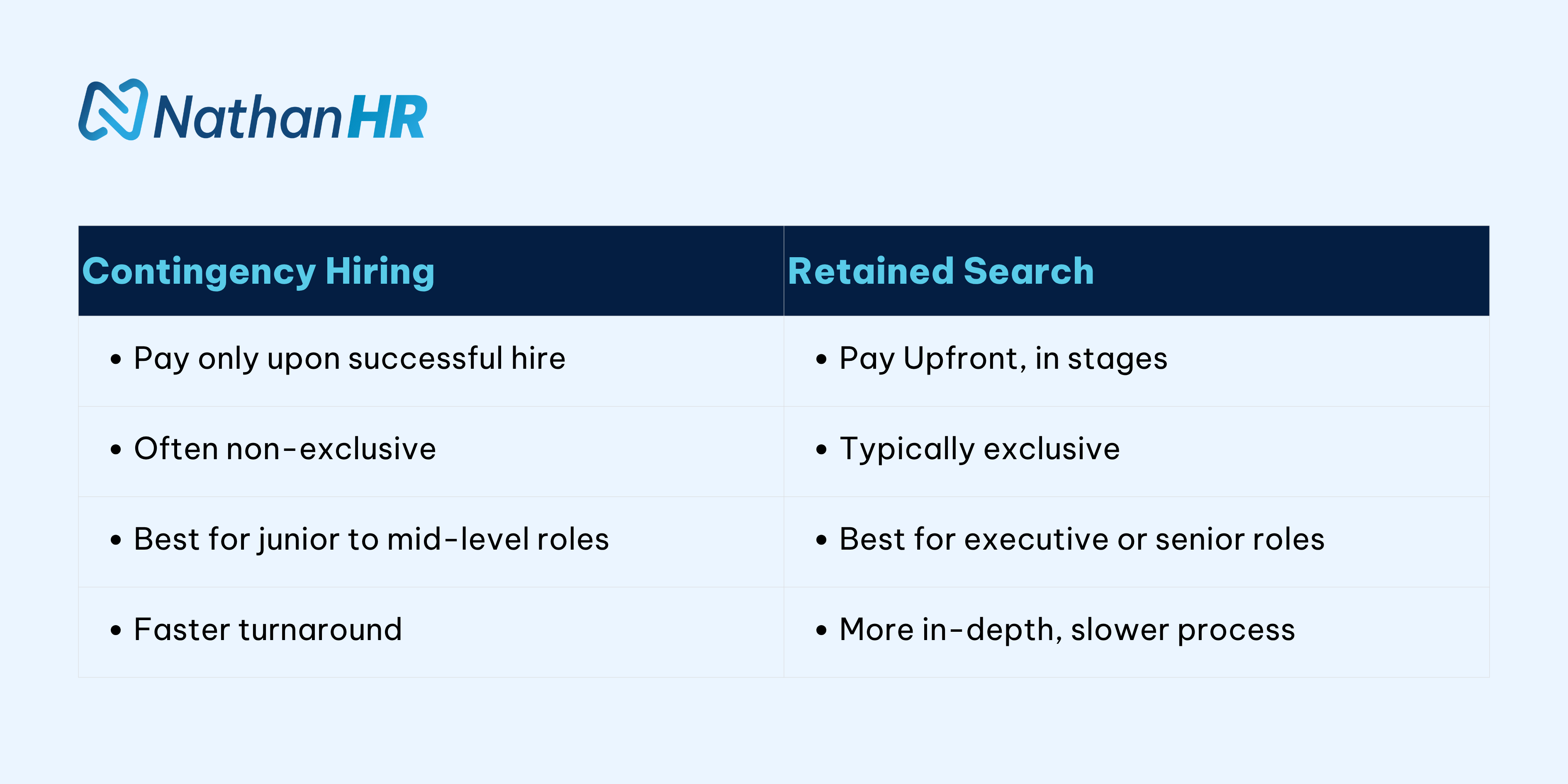
Contingency vs. Retained Search
These two models are often compared. Here’s how they differ:
Pros and Cons of Contingency Hiring
Pros:
- No upfront costs: You only pay if the recruiter delivers.
- Quick access to candidates: Ideal for filling roles fast.
- Flexibility: Work with multiple recruiters at once.
- Lower risk: No financial commitment if no hire is made.
Cons:
- Less strategic alignment: Agencies may not deeply understand your culture or long-term goals.
- Inconsistent candidate quality: Some agencies may prioritize volume over fit.
- Duplicate submissions: Managing multiple recruiters can lead to overlap and confusion.
- Confidentiality risks: With more recruiters, it’s harder to control how your job opening is represented.
When to Use Contingency Hiring
Contingency hiring works well when:
- You’re hiring for non-executive roles or high-turnover positions
- You need to fill positions quickly due to business growth or urgent projects
- You want to test the market without committing to one provider
- You lack an internal recruitment team and need external reach
- You’re in an industry with high competition for talent, where speed is essential
Best Practices for Employers
To get the most out of contingency hiring:
Be clear about the role: Provide a well-defined job description, including must-haves, nice-to-haves, and the ideal candidate profile.
Streamline your hiring process: A slow or complicated hiring process can cause you to lose top candidates.
Limit the number of agencies: Working with too many firms can lead to disorganization and poor candidate experience.
Maintain regular communication: Share timely feedback and updates with recruiters to improve alignment.
Track your results: Monitor which agencies deliver consistent quality and build long-term partnerships based on performance.
Final Thoughts
Contingency hiring is a flexible, cost-effective way to access talent without upfront commitments. It’s well-suited for growing businesses or companies hiring at scale.
That said, success depends on clarity, speed, and choosing the right recruitment partners.
FAQs About Contingency Hiring
What is a contingency hire?
A contingency hire is a candidate placed by a recruitment agency that only gets paid if the employer hires that candidate.
Is contingency hiring good for senior roles?
Not usually. For senior or executive roles, a retained search model is better due to the complexity and confidentiality involved.
What is the typical fee for contingency recruitment?
It’s often 15% to 25% of the candidate’s first-year salary, but it can vary based on industry, role, and location.
Can I work with more than one recruiter under contingency?
Yes. That’s one of the key features of the model, you can work with multiple agencies at once to expand reach and speed up the process.
What types of roles are best suited for contingency hiring?
Entry to mid-level roles such as sales, admin, customer service, operations, and certain technical positions are often ideal for contingency recruitment.
How long does the contingency hiring process usually take?
It varies, but most roles are filled within 2 to 4 weeks when working with responsive, experienced recruiters and a fast-moving internal process.