.png&w=3840&q=75)
An Employer of Record (EOR) is a third-party service that takes care of the legal aspects of employment, like payroll, taxes and compliance. This allows you to focus on managing your employees’ day-to-day work. It’s especially useful for businesses hiring in foreign markets like the where local laws can be complex.
If you're a business owner in the UAE (or planning to expand here), you've probably heard the term "Employer of Record" (EOR) being tossed around.
But what exactly is an Employer of Record, and how can it benefit your business?
Let’s break it down in a simple, straightforward way so you can make informed decisions about whether an EOR is the right move for your company.
What Exactly is an Employer of Record (EOR)?
An Employer of Record (EOR) is a third-party organization that takes on the legal responsibilities of being an employer for your employees while you still manage their day-to-day work.
In simple terms, the EOR becomes the official employer in the eyes of the law, but you maintain control over the employee's role, responsibilities and workflow.
Here's how it works: You hire an employee, but the EOR handles the legal side of things, like payroll, taxes, benefits, and compliance with local labour laws.
This can be a huge relief for companies that are either expanding into new regions or don’t want to get bogged down by the complexities of HR administration.
How Does an EOR Differ from a PEO?
Many companies mix up EORs and PEOs because both provide HR support, payroll help, and compliance guidance. But the structure behind each service is very different and understanding that difference is critical before choosing a partner.
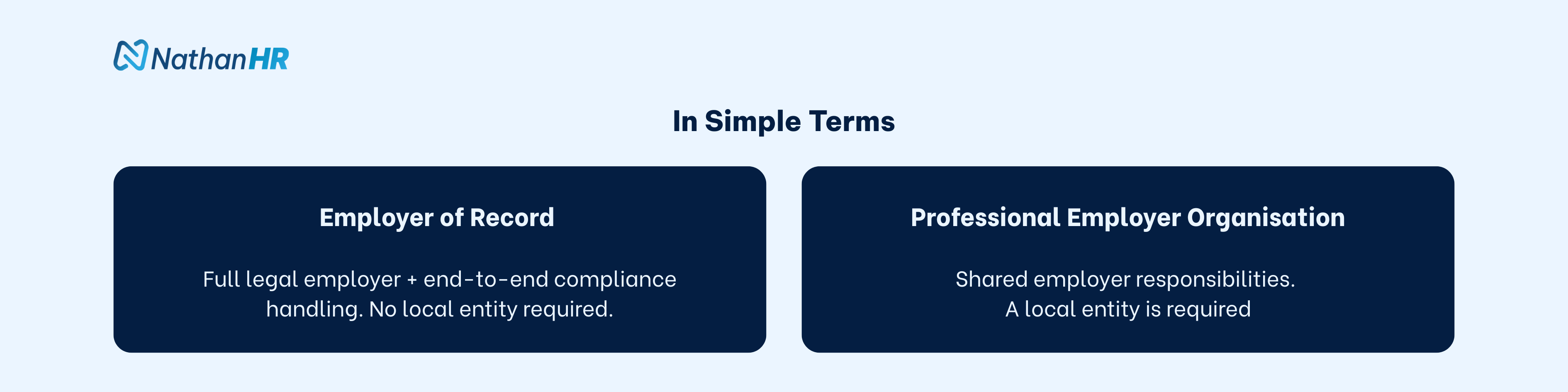
An Employer of Record (EOR) becomes the legal employer of your staff. This means the EOR handles everything tied to compliance: visas, contracts, payroll, government relations, and statutory obligations.
You still manage the employees’ daily work, performance, goals, and culture but the EOR takes on the legal burden and administrative responsibilities.
A Professional Employer Organization (PEO) works under a co-employment model.
You and the PEO share certain employer responsibilities. Your company still needs to have a legal entity in the country, because the PEO does not take over full legal employment.
Instead, they support your HR operations while you remain the primary employer of record.
Choosing between the two depends on your goals:
Use an EOR if you want speed, compliance certainty, and the ability to hire in a country without setting up a legal entity.
Use a PEO if you already have a local presence and prefer a shared HR support model rather than outsourcing the full legal structure.
What an EOR Handles
When companies expand into new markets, the operational workload can grow faster than the team can keep up. An Employer of Record steps in to absorb that complexity. Instead of spending hours coordinating legal paperwork, payroll runs, or visa requirements, companies rely on an EOR to take full responsibility for day-to-day employment administration. This allows internal teams to focus on strategy while the EOR manages the regulatory, administrative, and compliance-heavy tasks that often slow expansion efforts.
Core responsibilities typically include:
-
Employment contracts & onboarding: Drafting compliant contracts and managing new employee setup based on UAE or GCC labour laws.
-
Payroll administration: Handling monthly payroll, allowances, end-of-service accruals, deductions, and payslips.
-
Visa & work permit processing: Managing the entire visa cycle from application and medical testing to renewals and cancellations.
-
Compliance monitoring: Ensuring the business meets all labour, tax, immigration, and statutory obligations.
-
Employee benefits administration: Coordinating insurance, leave management, and mandatory benefits.
-
HR support: Acting as the legal employer and providing day-to-day HR support to staff on behalf of the client.
The idea is simple: the EOR manages the people operations, while the client manages the employee’s actual work.
Benefits of Using an EOR
Companies often underestimate how much time and money disappear into administrative work, payroll cycles, visa follow-ups, contract updates, and compliance checks.
After reviewing hundreds of HR operations across the UAE and GCC, one pattern is consistent: an EOR significantly reduces compliance exposure, operational workload, and expansion delays.
It also gives businesses the agility they need during scaling, restructuring, or entering new markets.
Below is a more detailed look at the real advantages.
1. Faster Market Entry
Establishing a legal entity in the UAE or GCC can take weeks to several months, depending on the emirate or country. During that time, you can’t legally hire, sponsor visas, or run payroll.
An EOR removes this barrier completely. You can hire talent immediately, issue compliant contracts, and start operations while bypassing lengthy setup, licensing, and government approvals.
2. Lower Compliance Risk
Labour laws in the GCC are strict and updated frequently especially around visas, end-of-service, working hours, and employee benefits. Non-compliance can lead to fines, visa blocks, or contract disputes.
An EOR continuously monitors regulatory changes and ensures:
-
Contracts meet local labour standards
-
Visas and work permits are issued correctly
-
Payroll aligns with WPS and statutory requirements
-
Terminations follow legal procedure
This shifts the legal exposure away from your business and onto the EOR.
3. Reduced Administrative Costs
Running HR in-house is expensive. You need:
-
Payroll specialists
-
PROs for visa and government work
-
HR administrators
-
Compliance officers
Each function has its own tools, workflows, and overhead. An EOR consolidates all of this under one service, reducing fixed staffing costs and minimizing the chances of manual errors.
4. Support for Remote or Distributed Teams
Hiring across different emirates or countries often requires separate entities, licenses, and payroll registrations.
An EOR removes that limitation by allowing you to:
-
Hire in any emirate within the UAE
-
Build teams across the GCC
-
Operate without forming multiple companies
This is particularly valuable for hybrid companies, global teams, or businesses testing new markets.
5. Peace of Mind for HR Teams
Your internal HR shouldn’t spend their time tracking visa renewals, preparing payroll files, or resolving WPS submissions.
By offloading the operational work to an EOR, your HR team can focus on:
-
Culture and engagement
-
Talent development
-
Recruitment strategy
-
Retention initiatives
This shift turns HR into a strategic function instead of an administrative one.
6. Flexibility for Project-Based Hiring
Many businesses in construction, tech, events, healthcare, and consulting rely on short-term or project-based staff. Setting up contracts, payroll, and visas for temporary hires is expensive and time-consuming.
An EOR gives you the flexibility to:
-
Hire short-term staff legally
-
Onboard and offboard quickly
-
Avoid long-term contractual commitments
-
Scale headcount up or down as projects change
This agility is especially important when business volume fluctuates.
What to Evaluate Before Choosing an EOR
Choosing an Employer of Record is not a small decision, especially in the UAE and GCC, where labour laws, visa rules, and compliance requirements vary significantly across countries. The wrong partner can slow down your hiring, frustrate employees, and expose you to compliance risks you may not even know exist.
Below is a deeper look at the key factors you should evaluate, based on what HR professionals typically scrutinize before selecting an EOR in this region.
1. Local Expertise in the UAE and GCC
Labour regulations in Saudi Arabia are not the same as in the UAE. Qatar’s visa processes differ from Oman’s. Bahrain has its own HR regulatory structure.
This is why the EOR you choose must have hands-on, proven experience across the Gulf, not just generic “Middle East” claims. They should understand:
-
How visa classifications differ
-
Country-specific payroll requirements
-
Local labour inspection practices
-
Variations in employee benefits and statutory obligations
A partner who has operated on the ground (not just through subcontractors) will help you avoid delays, non-compliance, and employee frustration.
2. Transparency in Pricing
EOR pricing is one area where many companies get surprised, usually because of unclear or incomplete cost breakdowns. A reputable EOR should be upfront about every fee involved.
Make sure you have clarity on:
-
Monthly management fees (per employee)
-
Visa, onboarding, and government fees
-
End-of-service calculations and annual leave accrual costs
-
Any additional charges for contract amendments, cancellations, or urgent processing
If an EOR’s proposal looks “too good to be true,” it usually means the hidden fees are coming later.
3. Payroll Accuracy and Timelines
Payroll errors are more than mistakes in the UAE and GCC, they can affect an employee’s ability to send money home, pay rent, or maintain their visa status.
During evaluation, ask:
-
What technology powers their payroll system?
-
How do they verify employee data each month?
-
What is their internal approval workflow?
-
How often do they conduct audits and accuracy checks?
Consistent, timely payroll builds trust. One delayed cycle can damage employer reputation permanently.
4. Visa Processing Efficiency
The visa process is often the biggest contributor to employee stress and business delays. A strong EOR should have a clear, documented process and realistic timelines based on how government systems operate in each country.
Evaluate:
-
Their average visa turnaround time
-
Steps taken to prevent delays
-
How they handle exceptional cases (e.g., medical test issues, rejections)
-
Their communication process during each stage
An efficient visa partner keeps employees confident and helps your business stay agile.
5. HR Support Quality
When you use an EOR, your employees interact with their HR team not yours. This makes service quality one of the most important factors in the entire decision.
Assess how they handle:
-
Employee queries
-
Conflict management
-
Contract updates
-
Leave requests
-
End-of-service procedures
Fast, respectful, and knowledgeable HR support creates a positive employee experience, slow or unclear communication does the opposite.
6. Technology and Reporting
Visibility is non-negotiable. You need to see exactly what is happening with your workforce, without emailing someone every time you need a document.
A solid EOR platform should provide:
-
Contract status and renewals
-
Payroll history and approvals
-
Attendance and leave records
-
Visa and immigration updates
-
End-of-service calculations
If the system feels outdated or lacks detailed reporting, that’s a serious red flag, it means more manual work and more time spent chasing information.
7. Scalability
Your workforce needs today might be small but what about next year? Or when you enter another GCC market?
Your EOR should be able to support:
-
Rapid hiring spikes
-
Multi-country expansion
-
Multiple roles and contract types
-
High-volume onboarding
Scalability matters because switching EOR partners mid-expansion is complicated and disruptive to employees.
8. Reputation and Client Feedback
EOR services rely heavily on trust. Before choosing a partner, look beyond their marketing material.
Check:
-
How long they’ve operated in the UAE
-
Whether they have regional teams or rely on third parties
-
Case studies or real success stories
-
Client reviews (especially from similar industries)
-
Their legal standing and government relations
A partner’s reputation often reflects how they will handle your employees and how they will support you under pressure.
Conclusion
Using an Employer of Record in the UAE can be a smart move for companies looking to hire employees without dealing with the complexities of local labour laws, visas, and payroll.
It’s a cost-effective and efficient solution, especially for international companies or startups wanting to expand quickly.
At Nathan HR, we specialize in offering Employer of Record services right here in the UAE, helping businesses like yours navigate the complexities of local employment while focusing on growth.
If you’re considering expanding to the UAE or simply looking for an easier way to manage your HR processes, working with an EOR could be the perfect fit.
It’s all about simplifying the hiring process while ensuring compliance, so you can focus on what matters most, growing your business without the limits of setting up an entity.
.avif&w=3840&q=75)