
NathanHR

Workforce Mobilisation UAE: From Hiring to Deployment

October 12, 2026
05:54 AM
Workforce Mobilisation UAE: From Hiring to Deployment

Table of Content

    Workforce mobilisation in the UAE (also written workforce mobilization) is the set of employment, immigration and payroll steps that make a selected worker legally ready to start work. It covers the employment model, work permit, residency, health insurance and payroll.

    The route depends on who employs the worker, where they will work and whether they are already in the UAE. Our workforce mobilisation service handles these steps for contractors deployed under our visa and payroll.

    How Is Workforce Mobilisation Different From Recruitment?

    Recruitment identifies and selects the right person. Mobilisation turns that selection into lawful, operational deployment.

    A selected candidate has accepted an offer. A mobilised worker holds a valid work permit under the correct sponsor, has completed the residency steps that apply to them, is insured, is on payroll and can start on the agreed date. Some businesses arrive with candidates already chosen and need only these steps handled. Others need sourcing first, which for an ongoing role means permanent recruitment: sourcing, assessing and selecting a candidate who then joins the business as its own employee.

    Which Employment Model Will Your Workforce Use?

    The employment model decides who sponsors the worker, who holds the work permit and who carries the employer's legal obligations. This guide covers two models:

    • Direct employment: your UAE entity employs and sponsors the worker, applies for the work permit and holds every employer obligation. Government transactions such as staff visas, Emirates ID and medical administration can still be handled through public relations officer (PRO) services.

    • Temporary employment and outsourcing: an agency licensed by the Ministry of Human Resources and Emiratisation (MOHRE) employs the worker and makes them available to your business, the arrangement behind MOHRE-licensed temporary and contract staffing. These activities are regulated under Cabinet Resolution No. 1 of 2022, the implementing regulation of the UAE Labour Law.

    UAE legislation uses the term temporary employment and outsourcing rather than Employer of Record (EOR). It is also the structure through which a foreign company can employ staff in the UAE without its own local entity. Our EOR services operate through our MOHRE Temporary Employment and Outsourcing licences in Dubai and Abu Dhabi: we become the legal employer of a worker you have identified, and you direct their work.

    Who Is Responsible for What During Mobilisation?

    Responsibilities sit with whichever party is the legal employer, which changes with the employment model. Under temporary employment and outsourcing, the licensed agency is the employer. MOHRE's 2022 resolution on employment agencies, reported by the Emirates News Agency (WAM), requires the agency to meet an employer's legal obligations towards the worker, even where a beneficiary has not fulfilled its agreement, and sets separate obligations for beneficiaries.

    Table comparing responsibilities under direct employment and temporary employment and outsourcing in the UAE. Under outsourcing, the licensed agency handles sponsorship, contracts and wages, while your business directs the work and manages site safety.

    Agree this split in writing before mobilisation starts, including who approves payroll inputs and who manages the worker on site.

    Does Mobilisation Differ in Free Zones, DIFC and ADGM?

    Yes. Where the employer is licensed decides which authority processes the work permit and which employment law applies. Mainland employers apply to MOHRE, while free zone employers work through their free zone authority. The Dubai International Financial Centre (DIFC) and Abu Dhabi Global Market (ADGM) are financial free zones with their own employment laws.
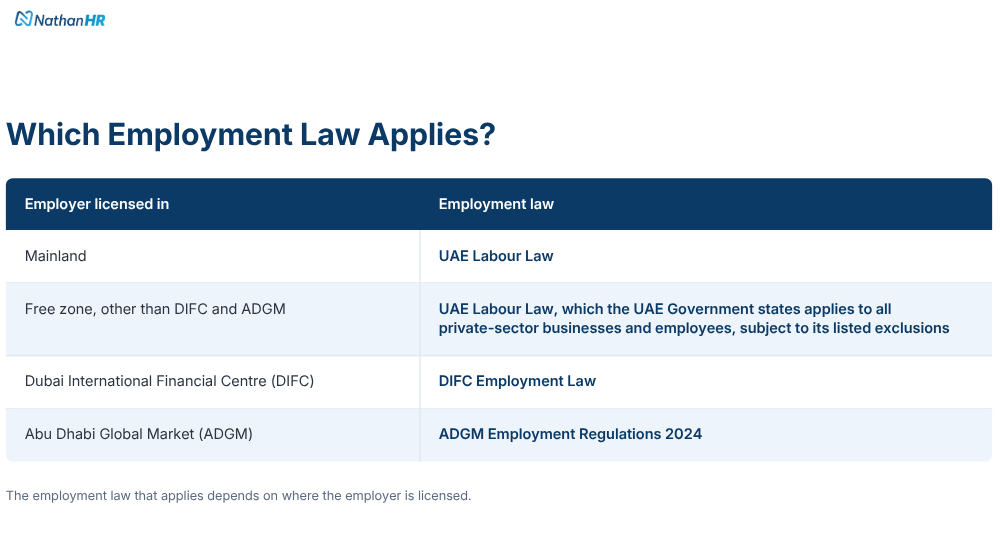
    Table showing which employment law applies in the UAE by jurisdiction: the UAE Labour Law for mainland and most free zones, the DIFC Employment Law for DIFC and the ADGM Employment Regulations 2024 for ADGM.

    Residence visas and Emirates IDs are issued at federal level through the Federal Authority for Identity, Citizenship, Customs and Port Security (ICP), with Dubai residency handled by the General Directorate of Residency and Foreigners Affairs (GDRFA).

    What Are the Steps to Deploy a Worker in the UAE?

    For a foreign national joining a mainland employer, the process can be broken into nine steps. The sequence follows the Dubai Government's private-sector employment process and the UAE Government's work permit guidance. Free zone, DIFC and ADGM employers follow their own authority's procedures.
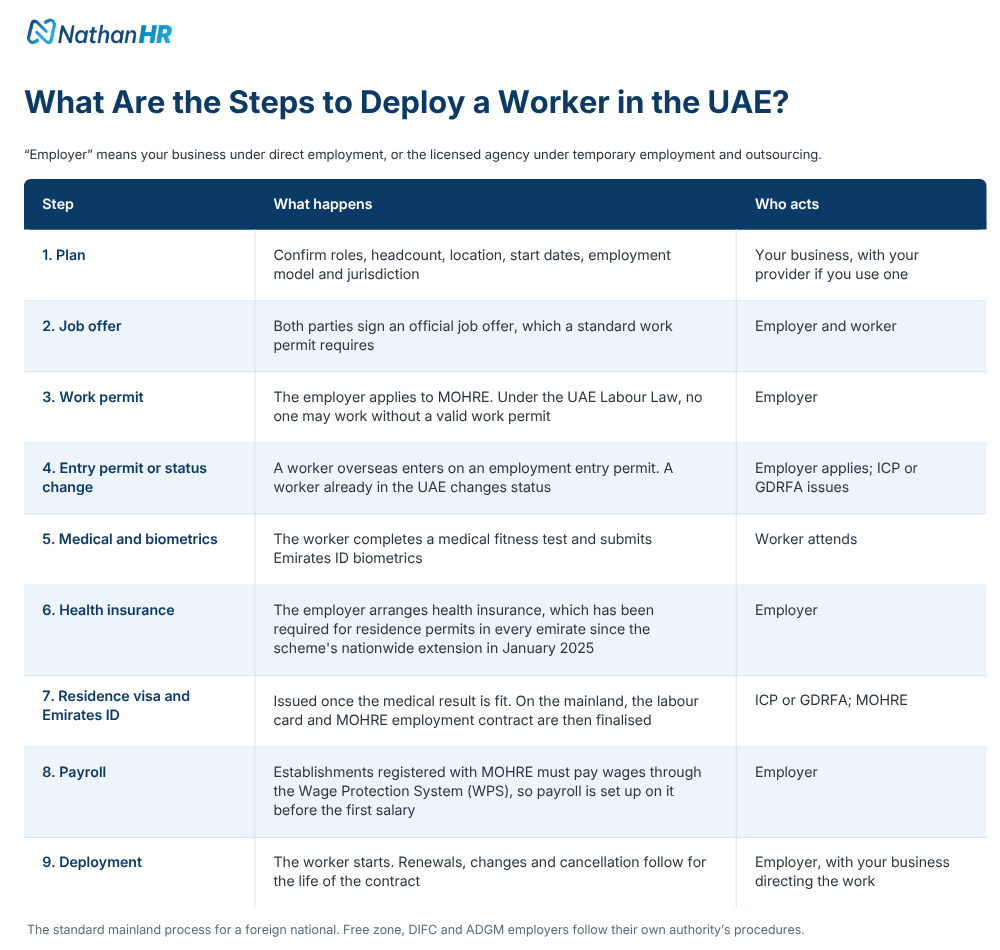
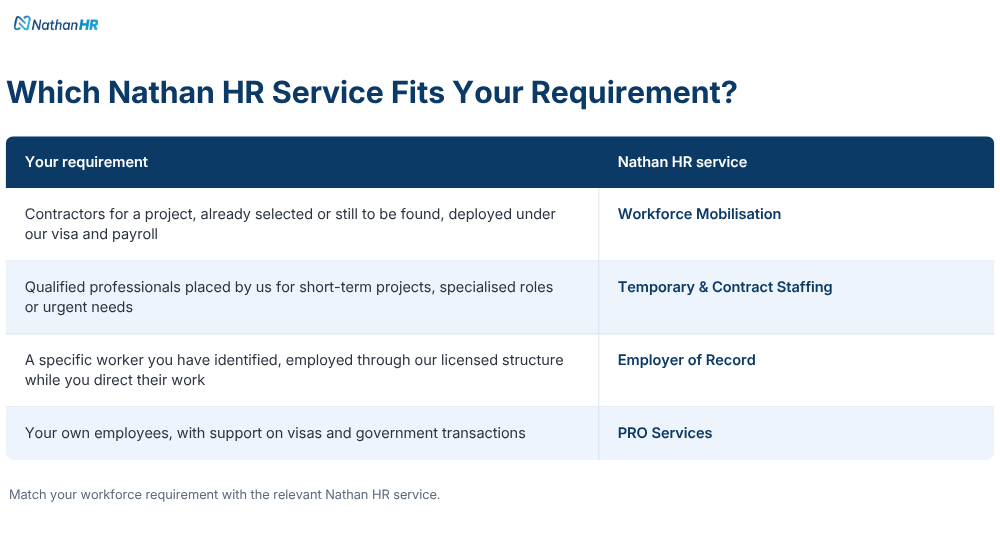
    Table of nine steps to deploy a foreign worker in the UAE mainland, from planning, job offer and work permit through entry permit, medical, health insurance, residence visa, payroll and deployment, showing who acts at each step.

    How Long Does Workforce Mobilisation Take in the UAE?

    There is no fixed timeline. Duration depends on the worker's nationality and location, the role, the authority involved and how complete the documents are when applications begin.

    The Work Bundle brings work permit, residency, medical and Emirates ID services into one platform. The UAE Government reports that it has reduced government processing to five working days, down from 30. Set start dates against confirmed approvals rather than this figure.

    Who Pays for Work Permits, Visas and Insurance?

    In the UAE, the employer pays for work permits, visas and mandatory health insurance. Federal Decree-Law No. 33 of 2021 prohibits employers from charging workers recruitment and employment fees or costs, directly or indirectly, and employers must buy health insurance as a condition of issuing or renewing residence permits.

    Under temporary employment and outsourcing, the agency is the employer and pays these costs.

    What Can Delay Workforce Mobilisation?

    Delays often trace back to an input that was missing or incorrect at an earlier step:

    • a late decision on the employment model, which holds every application behind it

    • compliance issues on the sponsoring establishment's file, since MOHRE can refuse new work permits to establishments with certain violations

    • incomplete or unattested documents

    • names or passport details that do not match across documents

    • a medical result not yet issued, which holds the residence visa

    • applying through the wrong authority for the jurisdiction

    • candidate notice periods that move the start date

    • unconfirmed payroll inputs that delay the first salary

    What Should Your Business Prepare Before Mobilisation Starts?

    No single document checklist applies to every worker, because requirements change with the employment model, visa status, jurisdiction and role. Preparing these inputs before the first application reduces rework:

    • headcount, roles, work location and jurisdiction

    • start dates and assignment duration

    • your preferred employment model

    • each candidate's current location and visa status

    • passport copies and photographs

    • educational certificates, attested where required, and professional licences for regulated roles

    • salary, allowances and benefits for each worker

    • the people who will approve offers, payroll inputs and changes

    How We Support Workforce Mobilisation

    Our workforce mobilisation service is for businesses that prefer not to hire contractors directly. We deploy contractors under our visa and payroll, working with candidates you have already selected or helping you find them. We have mobilised more than 2,500 contractors for over 850 businesses, across industries including construction, IT and healthcare.

    Our scope covers:

    • visa applications, permits, employment outsourcing and labour law compliance

    • payroll and benefits, with transparent pricing and no hidden fees

    • continuous support throughout the contract, including payroll queries and compliance updates

    Which of Our Services Fits Your Requirement?

    Table matching workforce requirements to Nathan HR services: Workforce Mobilisation, Temporary and Contract Staffing, Employer of Record and PRO Services.

    Plan Your Workforce Mobilisation

    If you are planning to deploy contractors or project staff in the UAE, we can assess your project requirements and the contractors involved, then confirm the service scope before mobilisation begins.

    Frequently Asked Questions

    Workforce mobilisation is the set of employment, immigration and payroll steps that make a selected worker legally ready to start work in the UAE. It covers the employment model, work permit, entry permit or change of status, medical fitness test, residence visa, Emirates ID, health insurance and payroll set-up.
    No. Under Article 6 of the UAE Labour Law, it is illegal to work in the UAE without a valid work permit issued by the Ministry of Human Resources and Emiratisation (MOHRE). Employers also may not recruit or employ a worker unless a work permit has been issued in line with MOHRE procedures.
    There is no fixed timeline. Duration depends on the worker’s nationality and location, the role, the authority involved and how complete the documents are. The UAE Government reports that the Work Bundle has reduced government processing to five working days, down from 30. Set start dates against confirmed approvals rather than this figure.
    The employer pays. Federal Decree-Law No. 33 of 2021 prohibits employers from charging workers recruitment and employment fees or costs, directly or indirectly. Employers must also buy health insurance as a condition of issuing or renewing residence permits. Under temporary employment and outsourcing, the licensed agency is the employer and pays these costs.
    Yes, except in the Dubai International Financial Centre (DIFC) and Abu Dhabi Global Market (ADGM). The UAE Government states that the Labour Law applies to all private-sector businesses and employees, subject to listed exclusions. DIFC applies the DIFC Employment Law and ADGM applies the ADGM Employment Regulations 2024.