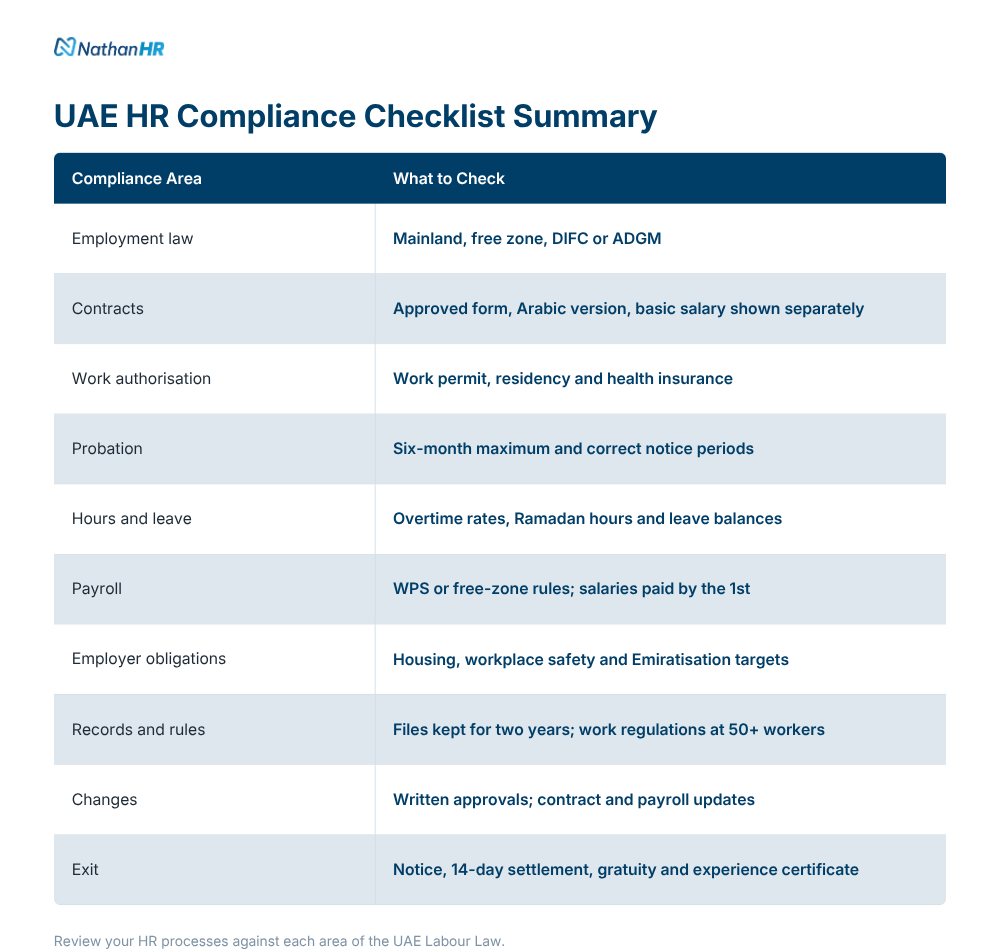
Employers in the UAE manage HR compliance across the whole employment relationship. This covers employment contracts, work permits, working hours, leave, payroll, employee records and end-of-service settlements. For private-sector employers on the mainland and in most free zones, the requirements are set by Federal Decree-Law No. 33 of 2021 (the UAE Labour Law), its Executive Regulations and resolutions issued by the Ministry of Human Resources and Emiratisation (MOHRE). This article sets out a checklist that follows the employee lifecycle, explains what each area requires, and shows where our HR, payroll and PRO services can support your team.
Companies in the Dubai International Financial Centre (DIFC) and Abu Dhabi Global Market (ADGM) operate under separate employment laws, and this checklist does not cover them in detail.
What Does UAE Labour Law Compliance Involve?
HR compliance applies at each stage of employment. Your obligations start with the job offer and include keeping employee records for at least two years after an employee’s service ends. Changes to salary, role or payroll arrangements need a matching update to the employment contract and employee records.
The Labour Law sets minimum entitlements for employees. Contracts and internal policies can provide more favourable terms. Any term that reduces a statutory entitlement is void.
UAE HR Compliance Checklist
1. Confirm Which Employment Law Applies
The applicable law determines how you apply every other point in this checklist.
The Labour Law covers private-sector employers and employees. Government employees, the armed forces, police and security services, and domestic workers fall outside its scope.
Most free-zone companies are subject to the Labour Law. The relevant free-zone authority manages company registration and visa procedures.
DIFC companies follow DIFC Employment Law No. 2 of 2019. ADGM companies follow the ADGM Employment Regulations 2024. Guidance on the ADGM regulations is available from the ADGM Employment Affairs Office.
2. Review Employment Contracts
The UAE Labour Law requires a written, fixed-term contract on the approved form, issued in two copies. The contract must be in Arabic, with a matching version in a language the employee understands. If the two versions conflict, the Arabic text prevails.
Each contract should show the employee’s current job title, place of work, working hours, probation period, notice period and salary. Basic salary should be listed separately from allowances, because overtime and gratuity are calculated on basic salary.
3. Confirm Work Authorisation Before the Start Date
A mainland employer needs a MOHRE work permit before an employee can start work. Recruitment and employment costs cannot be passed on to the employee. Free-zone employers should confirm whether their work permits are issued by MOHRE or by the free-zone authority.
Residency is handled through the Federal Authority for Identity, Citizenship, Customs and Port Security (ICP) or, in Dubai, the General Directorate of Residency and Foreigners Affairs (GDRFA). Since 1 January 2025, employers in all seven emirates have been required to provide health insurance when an employee’s residency permit is issued or renewed.
Record the expiry dates of work permits, residence visas and Emirates IDs so renewals can start on time. Our PRO services support these government transactions.
4. Track Probation Periods
Probation can last up to six months and cannot be extended. An employer ending employment during probation must give 14 days’ written notice. An employee moving to another UAE employer during probation must give one month’s notice, and an employee leaving the UAE must give 14 days. Paid sick leave does not apply during probation.
5. Manage Working Hours, Overtime and Leave
Normal working hours are 8 hours a day or 48 hours a week. During Ramadan, they are reduced by two hours a day.
Overtime is limited to two hours a day, except where the work is necessary to prevent a serious loss or accident. Overtime is paid at basic salary plus at least 25%. Between 10pm and 4am, the rate rises to basic salary plus at least 50%, except for shift workers.
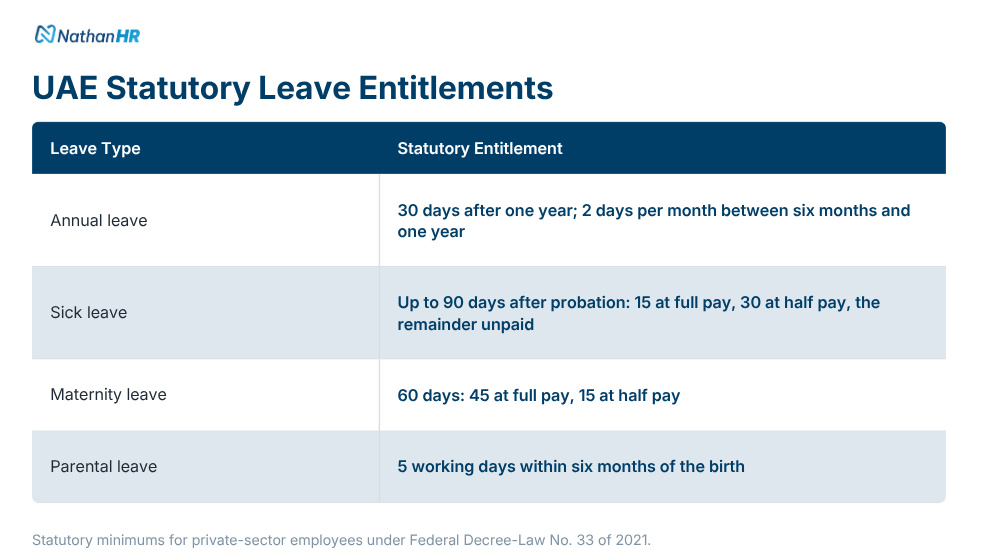
Leave records should reflect the following statutory leave entitlements:
6. Process Payroll Through the Correct Wage System
Establishments registered with MOHRE pay salaries through the Wage Protection System (WPS). Ministerial Resolution No. 340 of 2026 took effect on 1 June 2026. Under this resolution, salaries for each month are due on the first day of the following Gregorian month, and the previous 15-day grace period no longer applies. Employers that outsource payroll remain responsible for paying salaries on time.
Some free zones, including the Dubai Multi Commodities Centre (DMCC) and Jebel Ali Free Zone (JAFZA), have implemented WPS. Free-zone employers should confirm the applicable wage payment rules with their authority. Salary deductions are permitted only in the cases set out in the Labour Law, and total deductions cannot exceed 50% of the wage.
Our payroll service supports both WPS and non-WPS salary processing.