
NathanHR

Hiring Your First Employee in the UAE: What Foreign Companies Need to Prepare

October 6, 2026
09:15 AM
Hiring Your First Employee in the UAE: What Foreign Companies Need to Prepare

Table of Content

    To hire your first employee in the UAE, your company needs an appropriate employment route and the infrastructure to employ, authorise, pay, insure and administer that person.

    For a foreign company, the first decision is whether the employee will be hired through your own UAE employing entity or through an alternative structure such as an Employer of Record (EOR). That decision affects employer registrations, employment documentation, work authorisation, payroll, health insurance and ongoing HR administration.

    If you do not yet have a UAE employing entity, deciding how the person will be legally employed should be the first step.

    Can a Foreign Company Hire an Employee in the UAE?

    Yes. A foreign company can build a workforce in the UAE through direct employment using an appropriate UAE employing entity or, for eligible hires, through an EOR arrangement.

    Under direct employment, your UAE entity employs the individual and carries the responsibilities associated with the employment relationship.

    Under an EOR arrangement, the EOR acts as the legal employer while your organisation directs the employee’s day-to-day duties and business responsibilities.

    Do You Need a UAE Entity to Hire an Employee?

    You need an appropriate UAE employing entity if your company intends to employ the individual directly. An EOR can provide another route for eligible hires where the foreign company does not have its own UAE employing entity.

    Having UAE clients, projects or commercial activity does not by itself provide the employment infrastructure required for a direct hire.

    The requirements also depend on where the employing entity is established. Employers operating under the federal private-sector framework can have different administrative processes from businesses operating within individual free zones.

    This employment-route decision should be made early because it determines who will employ the worker and who will handle the associated employment administration.
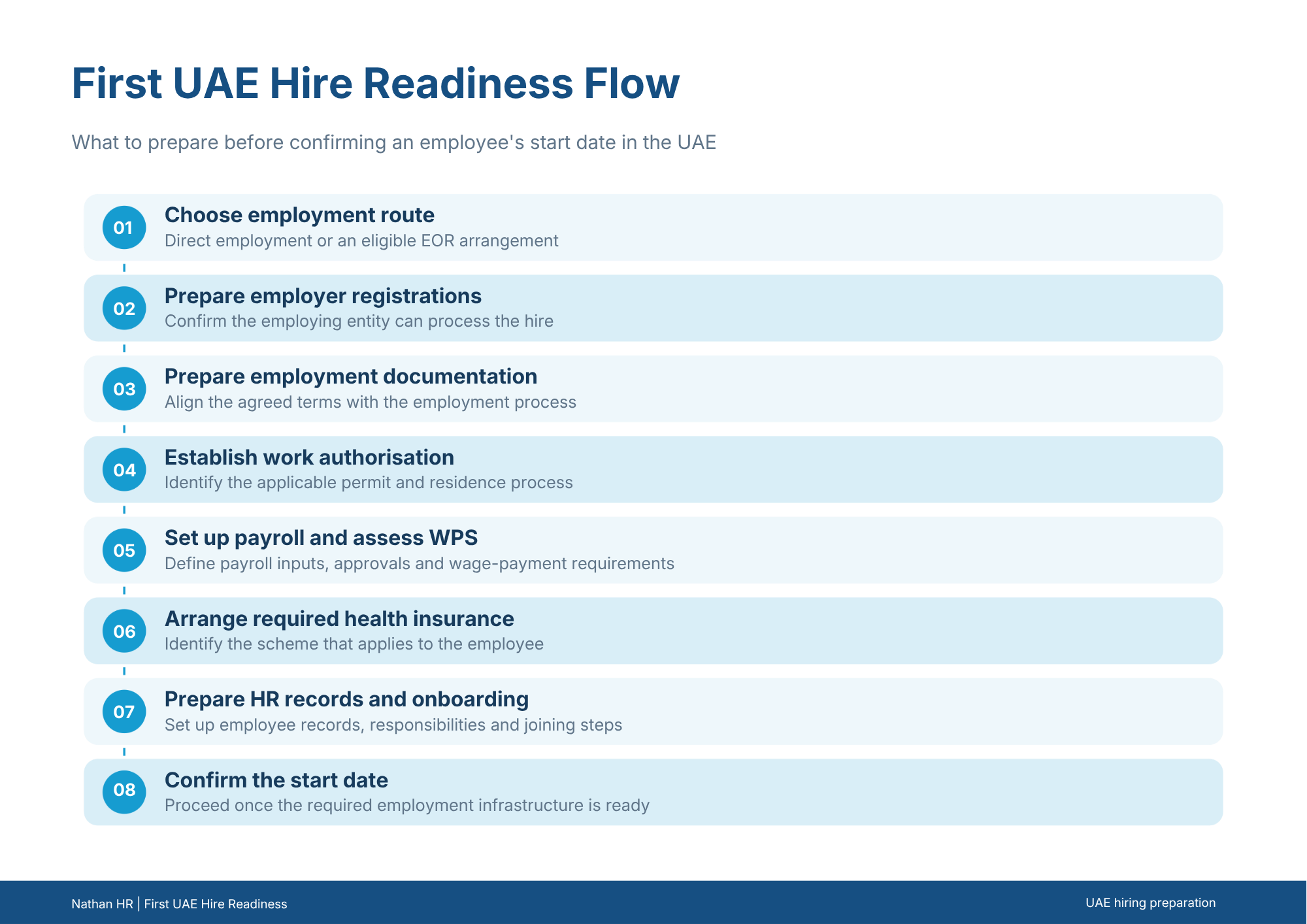
    Steps to prepare before hiring your first employee in the UAE

    What Employer Registrations Need to Be Ready?

    A company hiring directly needs the employer and immigration registrations required by the authorities governing its establishment and workforce.

    For employers covered by the relevant federal private-sector framework, the business needs the labour arrangements required to access employment services and process work permits. It also needs the applicable immigration establishment registration for relevant residence and immigration transactions.

    The Federal Authority for Identity, Citizenship, Customs and Port Security establishment-card service sets out establishment-card requirements and states that companies operating under a free-zone authority submit the service request through their respective free-zone authority.

    Before confirming a start date, establish that the employing entity can complete the employment and immigration transactions required for the proposed hire.

    What Employment Contract Should You Prepare?

    Your employment documentation should record the agreed terms of the role and meet the requirements of the authority governing the employment relationship.

    A recruitment-stage offer or job offer should be distinguished from the formal employment contract used for the UAE employment relationship.

    Before joining, the employee and employer should have agreed the role, job title, remuneration, salary components, allowances, work arrangements, probation terms, notice provisions and contractual benefits.

    The documentation should correspond with information submitted through the applicable employment process and supplied to payroll. Differences between the agreed package, employment records and payroll instructions can create avoidable administration later.

    The federal private-sector employment framework is set out in Federal Decree-Law No. 33 of 2021 Concerning Regulating Labour Relations.

    What Work Permit and Residence Process Is Required?

    Work authorisation and UAE residence status are separate elements of employing a foreign national.

    For direct employment, the employing entity needs to complete the work-permit process that applies to the hire. Where employer-sponsored residence is required, the wider process can involve entry or status procedures, medical fitness, biometric registration, Emirates ID and residence issuance.

    The UAE Government’s Work Bundle brings employment and residence-related services together for private-sector establishments, including services associated with hiring employees, work permits and residence.

    The process depends on the employing jurisdiction, immigration authority and the employee’s existing UAE residence status. A mainland hire and a free-zone hire should therefore not be assumed to follow an identical administrative route.

    Your company should establish which process applies before agreeing a joining date that depends on work authorisation.

    Our PRO services can support businesses with relevant government and immigration administration.

    What Payroll Setup Should Be Ready Before Your First UAE Hire?

    Your payroll process should be operational before the employee’s first salary becomes due.

    Start by defining the employee’s salary structure and components, payroll calendar, bank information and payroll data. You also need a process for collecting, reviewing and approving payroll inputs.

    Consider how changes affecting salary will be handled. These can include leave inputs, reimbursements, deductions and changes to employee information.

    Responsibilities should also be assigned. Decide who prepares the payroll data, who checks it, who authorises payment and where payroll records will be retained.

    If you intend to outsource this function, allow enough implementation time to establish employee data, payroll inputs and approval responsibilities.

    Our guide to UAE payroll outsourcing explains the outsourcing model in greater depth.

    Does WPS Apply to Your First Employee?

    The Wage Protection System (WPS) is an electronic salary-transfer framework used for establishments and employees within its scope.

    Under the current framework, establishments registered with the Ministry of Human Resources and Emiratisation are required to pay employees’ wages on the due date through WPS, subject to the applicable exclusions.

    The UAE Government’s guidance on payment of salaries and wages sets out the current WPS framework and specified employee and employer exclusions.

    Employment jurisdictions within the UAE can operate under different wage-payment arrangements. Your business should establish which requirements apply to its employing structure and employee instead of assuming that every UAE employer processes salary through WPS in an identical way.

    This assessment should form part of payroll preparation before the first salary cycle.
    What Health Insurance and Benefits Should Be Arranged?

    Required employee health insurance needs to be addressed as part of first-hire preparation.

    Mandatory health-insurance requirements now apply to private-sector employees across the UAE, although the applicable scheme and administration differ by emirate and employment arrangement.

    The UAE Government provides current guidance on health insurance for private-sector employees, including the requirements introduced for private-sector workers in Sharjah, Ajman, Umm Al Quwain, Ras Al Khaimah and Fujairah from 1 January 2025.

    Your company should identify the health-insurance requirements attached to the hire and arrange the required cover at the appropriate point in the employment and residence process.

    Keep mandatory requirements separate from benefits offered through company policy or contract. Enhanced medical insurance, life cover and other employee benefits depend on the package the employer chooses to provide unless another requirement applies.

    What HR Records and Processes Should Be Ready?

    Even your first UAE employee needs an organised employee record and defined HR processes.

    Under Federal Decree-Law No. 33 of 2021, employers covered by the federal private-sector framework have statutory record-keeping obligations. Article 13 requires employers to maintain worker files and records and retain a worker’s file for at least two years after the end of service.

    From an operational perspective, decide how you will maintain employment documents, leave records, working-time or attendance information where relevant, payroll changes, policy acknowledgements, probation documentation, employee requests, manager approvals and employment correspondence.

    The process should reflect the size and needs of your workforce. A business hiring one employee does not require the same HR infrastructure as an organisation managing hundreds of workers, but responsibility for maintaining employment information still needs to be assigned.

    What Should Be Included in First-Hire Onboarding?

    First-hire onboarding should bring employment administration and workplace preparation together in one controlled process.

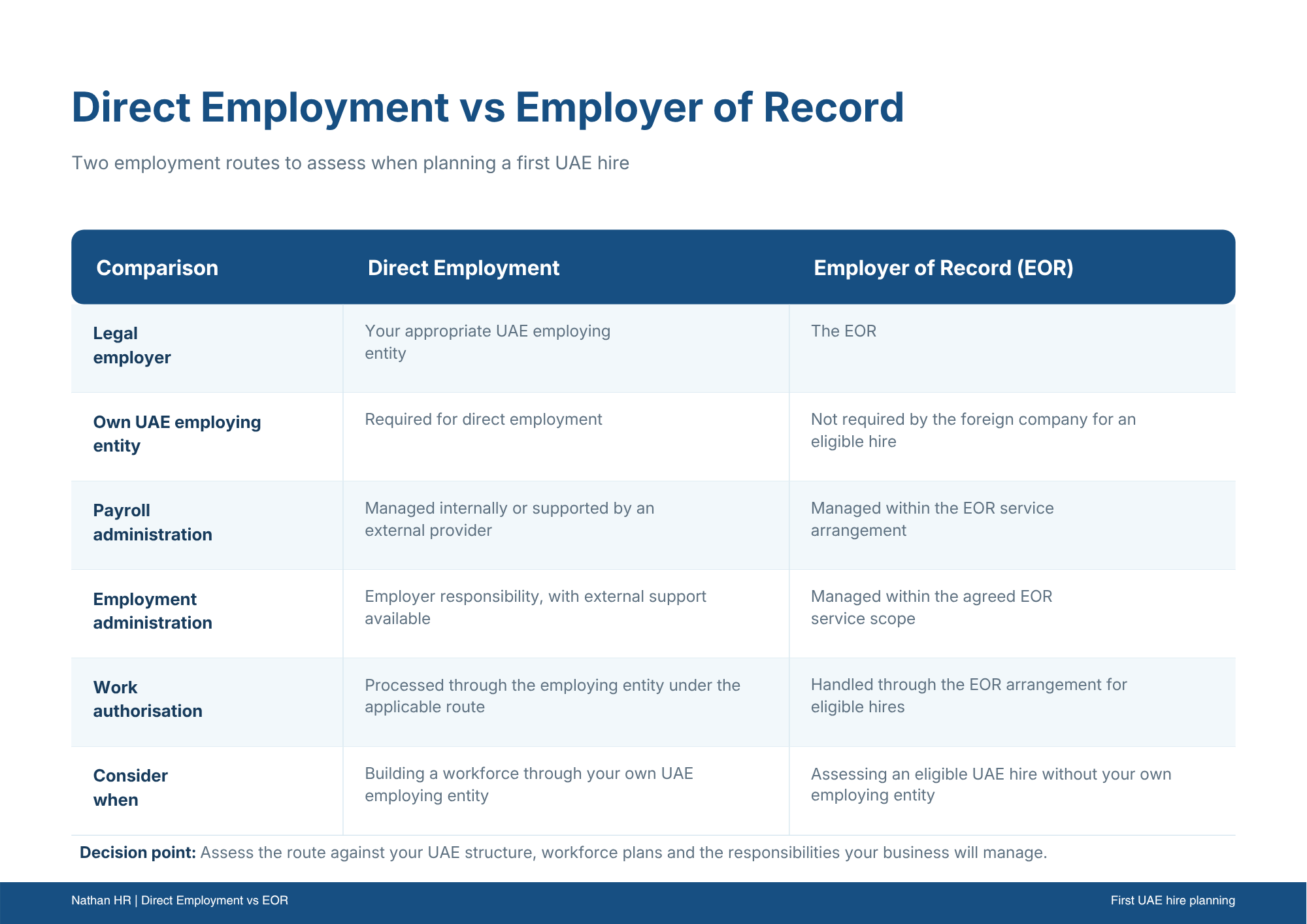
    Direct employment and Employer of Record options for a first UAE hire

    Confirm the applicable employment documentation, work-authorisation status, employee identification, payroll and bank information, required insurance and employee records.

    The employee should also receive the policies relevant to their role, system access, reporting information, job responsibilities, leave information, internal contacts and probation expectations.

    Documenting these steps creates an onboarding process that can be reused as the UAE workforce grows.

    Can You Recruit Before the Employment Setup Is Finished?

    Yes. Workforce planning, candidate sourcing and interviews can begin while the company prepares parts of its UAE employment infrastructure.

    Before making firm joining commitments, establish who will employ the candidate, how work authorisation will be handled, how salary will be processed and what needs to happen before the proposed start date.

    This is particularly important where the employee requires employer-sponsored work and residence arrangements.

    What Does Your First UAE Employee Cost?

    The cost of employing your first person in the UAE extends beyond salary.

    Your workforce budget can include salary and allowances, work-authorisation and residence administration where applicable, health insurance, recruitment, payroll and HR administration, end-of-service exposure and contractual benefits.

    The total depends on the employment structure, employee profile, jurisdiction and benefits package. These variables should be considered when setting the first-hire budget instead of relying on a single UAE hiring-cost estimate.

    Should You Hire Directly or Use an Employer of Record?

    The appropriate route depends on your UAE operating structure, workforce plans and the employment infrastructure you already have.

    Direct employment can suit businesses that already have an appropriate UAE employing entity, intend to build a sustained local operation and want the employment relationship within their own entity. Payroll, HR and government administration can then be managed internally or supported by external providers.

    An EOR can suit eligible foreign businesses planning a UAE hire without their own local employing entity. It can also be considered where a company is assessing an initial UAE workforce requirement before building its own local employment infrastructure.

    Under Nathan HR’s Employer of Record model, Nathan HR acts as the legal employer for eligible workers while the client retains operational direction over their duties. The published service scope includes employment documentation, work permits and residence processes, payroll and WPS administration, leave administration, medical-insurance arrangements and end-of-service processes.

    How We Support Foreign Companies Making Their First UAE Hire

    The support your business needs depends on the employment route and infrastructure you already have.

    No UAE employing entity: Our Employer of Record service can provide an employment route for eligible hires while your organisation directs the employee’s day-to-day work.

    UAE entity already established: Our payroll services, HR outsourcing services and PRO services can support salary administration, employee processes and relevant government transactions.

    Role identified but candidate not hired: Our permanent recruitment services can support candidate sourcing and selection.

    Employee benefits being established: We can support insurance procurement through licensed insurance brokers.

    For your first UAE hire, the key is to identify which responsibilities your business will manage internally and where local employment, payroll, immigration or HR support is required.

    Planning Your First UAE Hire?

    Before setting a start date, make sure the employment route, work authorisation, payroll and HR administration are ready.

    Tell us about the role you plan to hire and your current UAE setup. We can help you identify the employment and HR support required before the employee starts.

    Frequently Asked Questions

    Yes. A foreign company can employ someone through an appropriate UAE employing entity or consider an Employer of Record arrangement for an eligible hire. The appropriate route depends on the company’s UAE structure and workforce plans.
    A company intending to employ someone directly needs an appropriate UAE employing entity. An Employer of Record can provide another employment route for an eligible hire where the foreign company does not have its own UAE employing entity.
    Prepare the employment route, required employer registrations, employment documentation, work-authorisation process, payroll, applicable WPS arrangements, required health insurance, employee records and onboarding process before confirming the employee’s start date.
    An Employer of Record can provide an employment route for eligible hires where a foreign company does not have its own UAE employing entity. The EOR acts as the legal employer while the client organisation retains operational direction over the employee’s work.
    With direct employment, the worker is employed by the company’s appropriate UAE employing entity. Under an EOR arrangement, the EOR acts as the legal employer for an eligible worker and manages agreed employment administration while the client directs the employee’s day-to-day duties.