
NathanHR

Employee Termination in the UAE: A Practical Guide

October 30, 2026
06:20 AM
Employee Termination in the UAE: A Practical Guide

Table of Content

    When an employer ends a contract, a lawful employee termination in the UAE needs four things: a legitimate reason, the correct legal route, written notice (or payment of the notice allowance), and full final dues paid within 14 days. The employer then cancels the work permit and residence visa through the competent authority.

    Under the federal private-sector framework, notice is 30 to 90 days, termination during probation needs at least 14 days' written notice, and dismissal without notice is limited to specific misconduct after a written investigation.

    This guide turns the rules on termination of employment in the UAE into an eight-step employer workflow; the order is practical, not a legal requirement. DIFC and ADGM employers, government entities and domestic workers follow different rules, so confirm your regime first.

    The Employee Termination Process in Eight Steps

    The employee termination process in the UAE follows eight practical steps:

    1. Confirm which employment rules apply.

    2. Identify the reason and the legal route.

    3. Check the contract, notice period and probation terms.

    4. Communicate and document the decision.

    5. Manage the notice period and handover.

    6. Calculate and pay final entitlements.

    7. Complete work-permit and residence procedures.

    8. Close out records, access and assets.
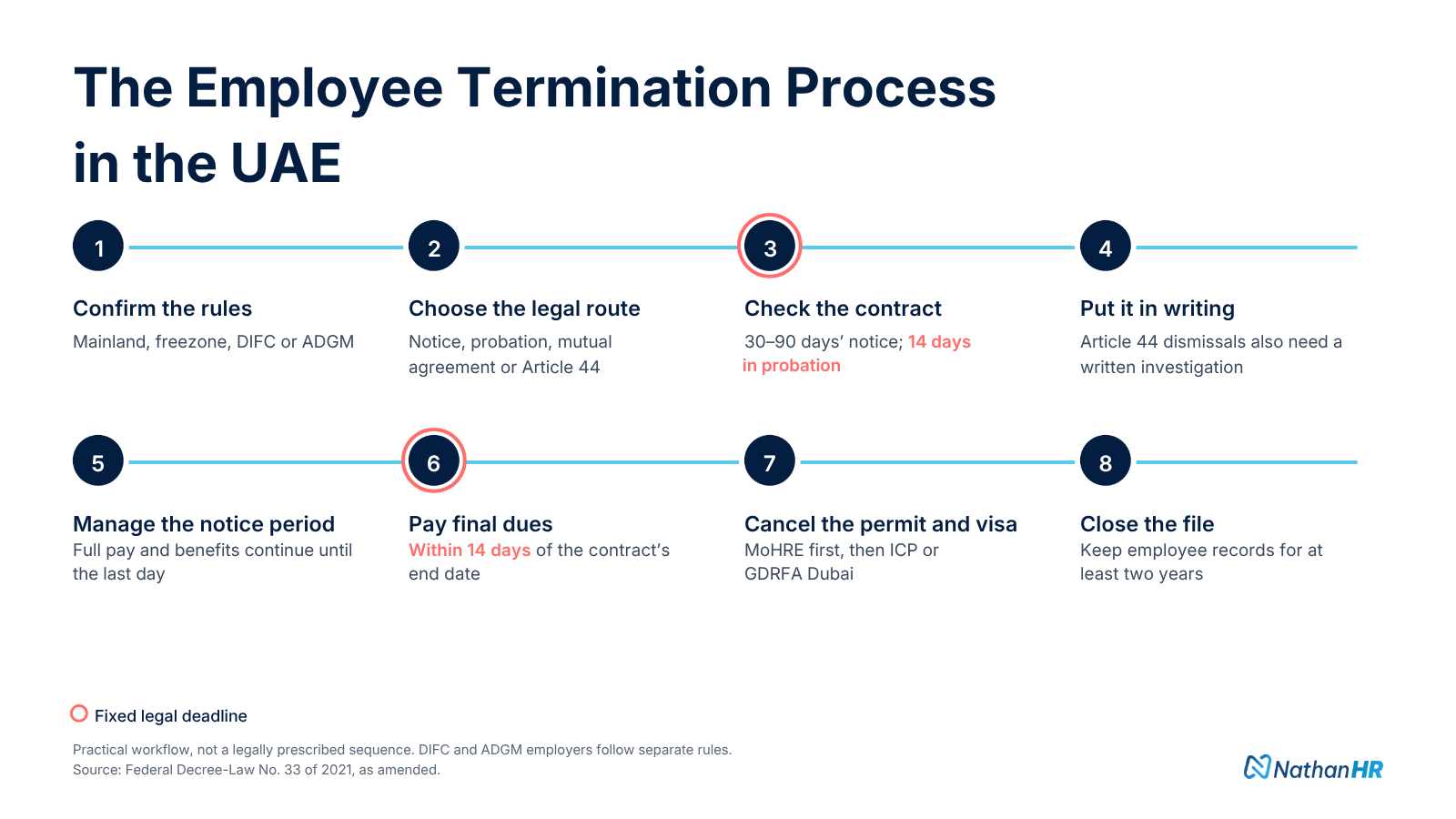
    Eight-step employee termination process in the UAE, from confirming the applicable rules to paying final dues within 14 days and cancelling the work permit and visa.

    Step 1: Confirm Which UAE Employment Rules Apply

    Jurisdiction and employee category decide which rules apply and which authority you deal with.

    Federal Decree-Law No. 33 of 2021 (the UAE Labour Law) covers private-sector employers and workers. It excludes government employees, armed forces, police and domestic workers (Article 3).

    • Mainland employers follow the UAE Labour Law and Ministry of Human Resources and Emiratisation (MoHRE) procedures.

    • Most free-zone employers follow free-zone regulations alongside the UAE Labour Law, with permits and visas handled by the free-zone authority, as the UAE Government's guidance on recruiting in free zones confirms.

    • DIFC and ADGM employers have their own employment frameworks, so this guide does not apply to them.

    UAE nationals receive end-of-service benefits under pensions legislation, and part-time workers follow the Implementing Regulation rather than the full-time gratuity formula (Articles 51 and 52). Our guide to employing people in the UAE covers jurisdiction in more detail.

    Step 2: Identify the Reason and the Legal Route

    Under UAE labour law, termination must follow a recognised route, which decides whether notice applies and what process is required.

    How can an employment relationship end?

    Route

    What it means

    Notice

    Legal basis

    Mutual agreement

    Both parties agree in writing

    As agreed, without reducing the worker's rights

    Article 42

    Contract expiry

    The fixed term ends. If both parties keep working without a new agreement, it is extended on the same terms

    Per the contract

    Articles 8 and 42

    Termination with notice

    Either party ends the contract for a legitimate reason

    30 to 90 days in writing

    Article 43

    Termination during probation

    The employer ends employment within probation

    At least 14 days in writing

    Article 9

    Dismissal without notice

    The employee commits listed misconduct

    None, but a written investigation and reasoned written decision are required

    Article 44

    Record resignations separately from dismissals, even though the same notice rules apply.

    Can poor performance or redundancy justify immediate dismissal?

    No, not as a rule. Both follow the notice route with full entitlements. Article 44 only allows dismissal without notice for poor performance after a written investigation and two written warnings.

    Which reasons make a termination unlawful?

    Termination breaches the law, whatever notice is given, if it is based on:

    • A serious MoHRE complaint or valid lawsuit against the employer (Article 47).

    • Pregnancy or maternity leave (Article 30).

    • Ill health, before the employee has used their accrued leave (Article 46).

    • Discrimination, including on race, sex, religion, national origin or disability (Article 4).

    For dismissals found unlawful under Article 47, a court can award up to three months' wages on top of notice pay and gratuity. The UAE Government's page on terminating employment contracts and arbitrary dismissal explains how complaints are handled.

    Step 3: Check the Contract, Notice Period and Probation Terms

    The contract sets the notice period and the law sets its limits. Check any non-compete clause too: it becomes void if the employer terminates in breach of the law (Article 10).

    What written notice is required?

    The UAE employment notice period must be 30 to 90 days, as set in the contract, and given in writing (Article 43). It must be the same for both parties unless a difference favours the worker. The parties can agree in writing to waive or shorten it, provided the worker's rights are preserved. Notice given during leave starts the day after the employee returns, unless both parties agree otherwise (Article 35).

    How does termination during probation differ?

    Probation lasts up to six months, once per employer, and the employer must give at least 14 days' written notice to end it (Article 9). The employee is still owed salary and unused leave, but no gratuity with less than one year of service.

    Pre-Notice Decision Checklist

    Use this before issuing notice. It reduces risk but cannot remove it.

    • Jurisdiction and employee category are confirmed, and the reason fits a recognised route.

    • No protected situation under Articles 4, 30, 46 or 47 applies, or we have taken advice.

    • Notice period, probation status, leave and contract expiry date are checked.

    • Any Article 44 dismissal is backed by a written investigation and, where relevant, warnings.

    • Final pay is estimated for payment within 14 days of the end date.

    Step 4: Communicate and Document the Decision

    A complete written record supports the decision if it is challenged.

    When can an employer terminate without notice?

    Only in the cases listed in Article 44, after a written investigation with the employee. The decision must be in writing, state the reasons and be handed to the employee.

    The cases include forged documents, a mistake causing gross material loss, safety breaches, intoxication or assault at work, and unexcused absence of more than 20 intermittent days a year or seven consecutive days. For gross material loss, MoHRE must be informed within seven working days.

    What should the termination letter include?

    As good practice, state the route, reason, notice start date, last working day and how final dues will be paid. Ask the employee to acknowledge receipt, and file the letter with the contract, warnings, investigation notes and settlement calculation.

    Step 5: Manage the Notice Period and Handover

    The contract, pay and benefits continue until notice ends.

    What must the employer do during the notice period?

    Pay the full wage, based on the last wage. The employee works if asked (Article 43), so the employer can also release them from attendance on full pay. When the employer ends the contract, the employee is entitled to one unpaid day a week to job-hunt.

    Use the period for handover: recover company property and confidential material (Article 16) and schedule access removal.

    What is notice pay?

    Notice pay, called the notice period allowance in the law, is owed when one party does not observe the notice period. It equals the worker's full wage, including allowances, for the notice period or the part not served (Article 43).

    Step 6: Calculate and Pay Final Entitlements

    All wages and entitlements must be paid within 14 days of the contract's end date (Article 53). Build the final settlement line by line, as each component has its own basis.

    What must be included in the final settlement?

    Component

    When it applies

    Calculation basis

    Final salary

    Always

    Salary to the last day, plus unpaid overtime

    Notice pay

    Notice not given or not fully served

    Full wage for the unserved notice (Article 43)

    Unused annual leave

    Accrued leave not taken

    Basic wage for accrued days (Article 29)

    End-of-service gratuity

    Eligible employees

    Last basic wage and continuous service (Article 51)

    Contractual payments

    Where the contract or policy provides them

    As set out, such as bonus or commission

    Repatriation cost

    Unless the employee joined another employer or caused the termination

    Return travel to the place of recruitment (Article 13)

    Deductions are limited to the cases in Article 25, and gratuity deductions to amounts payable under the law or a judgment (Article 51).

    When is end-of-service gratuity payable?

    End-of-service gratuity is a lump sum the law requires employers to pay eligible employees when employment ends. A full-time expatriate employee with at least one year of continuous service receives it, based on the last basic wage (Article 51):

    • 21 days' basic wage for each of the first five years.

    • 30 days' basic wage for each year after that.

    • A proportional amount for part-years, excluding unpaid absence, capped at two years' wage.

    See the UAE Government's page on end-of-service benefits for private-sector employees.

    Does termination or dismissal cancel gratuity?

    No. The law does not remove gratuity because the employer ended the contract, and Article 51 contains no general forfeiture for Article 44 dismissals. Termination as a disciplinary sanction expressly preserves end-of-service benefits (Article 39). Take advice before withholding any amount.

    How is gratuity calculated?

    For an expatriate employee with seven years of continuous full-time service and a last basic salary of AED 10,000 a month:

    1. Daily basic wage: AED 10,000 ÷ 30 = AED 333.33.

    2. First five years: AED 333.33 × 21 × 5 = AED 35,000.

    3. Years six and seven: AED 333.33 × 30 × 2 = AED 20,000.

    4. Total gratuity: AED 55,000.

    Our payroll specialists calculate end-of-service benefits and final settlements for clients through our HR outsourcing services.

    Step 7: Complete Work-Permit and Residence Procedures

    For a sponsored expatriate, the employer cancels the work permit, then the residence visa. A work permit is the authorisation to work for a specific employer; a residence visa is the permission to live in the UAE. Cancelling them does not settle anything still owed.

    What are the cancellation steps?

    For mainland employers, the UAE Government's guidance on cancelling a residence visa sets out this sequence:

    1. Apply to MoHRE to cancel the labour contract and work permit, signed by the employee.

    2. Submit a letter signed by the employee confirming receipt of all wages and end-of-service benefits.

    3. Apply to ICP, or GDRFA Dubai for Dubai-issued residence, to cancel the visa.

    Because of step 2, settle final dues first. Free-zone, DIFC and ADGM employers cancel through their own authority, so check its current steps before starting.

    Is there a grace period after visa cancellation?

    A grace period applies, but its length depends on the resident's category, up to six months under official guidance. Do not quote a fixed number of days; direct the employee to ICP or GDRFA Dubai.

    What does cancellation not change?

    Unpaid dues remain claimable, the employer must not keep the employee's passport (Article 13), and dependants' visas must be cancelled before the sponsor's. Our MOHRE-certified team handles work-permit and visa cancellations through our PRO services.

    Step 8: Close Out Records, Access and Assets

    Close the file once the employee has been paid. Record retention is a legal requirement; the rest is good practice.

    • Records: keep the employee's file for at least two years (Article 13).

    • Experience certificate: provide one free on request (Article 13).

    • Access, assets and benefits: remove system access, recover property and close or transfer health insurance.

    Common Employer Mistakes to Avoid

    • Using Article 44 without the required investigation and warnings.

    • Calculating notice pay on basic salary, or gratuity on the full wage.

    • Withholding gratuity because the employee was dismissed.

    • Missing the 14-day deadline or cancelling the permit before dues are paid.

    When Should You Seek HR or Legal Support?

    Take advice before acting in these cases:

    • Dismissal without notice under Article 44.

    • A pending or threatened MoHRE complaint or lawsuit.

    • Pregnancy, maternity leave or health-related issues.

    • Redundancies or a business closure.

    • UAE national employees.

    If an employee disputes a termination, MoHRE first attempts an amicable settlement and can decide claims of up to AED 50,000; other cases go to court (Article 54).

    Need Support With Employee Termination in the UAE?

    Employee termination in the UAE is manageable when you confirm the rules, choose the correct route, document the decision and pay final dues on time.

    We can run that process with you. Our team handles terminations, final settlement calculations, final payroll, and work-permit and visa cancellations, so deadlines are tracked and every decision is documented. AED 1.5bn in payroll ran through Nathan HR in 2025.

    If you are planning a termination or reviewing how exits are handled, book a consultation with our team.

    Frequently Asked Questions

    No. Under the UAE Labour Law, either party can end the contract with notice only for a legitimate reason. Termination is unlawful if it follows a serious MoHRE complaint or a valid lawsuit by the employee, and dismissal without notice is limited to the Article 44 cases after a written investigation. DIFC and ADGM employers follow their own rules.
    Yes, but the law treats it as not observing the notice period. The employer then owes the notice period allowance: the employee’s full wage for the notice period or the part not served. Alternatively, the employer can keep the employee on full pay without requiring attendance, or both parties can agree in writing to shorten notice while preserving the employee’s rights.
    Notice pay is calculated on the full wage, not just basic salary. Under Article 43, it equals the employee’s last wage, including allowances forming part of the wage, for the notice period or the part not served. Gratuity and unused leave are calculated on the basic wage, so keep each as a separate line in the final settlement.
    No, not automatically. The UAE Labour Law does not remove gratuity because the employer ended the contract, and Article 51 contains no general forfeiture for Article 44 dismissals. The employer can deduct only amounts payable under the law or a court judgment. Forfeiture rules from the previous labour law are still widely quoted, so take legal advice before withholding any gratuity.
    After final dues are paid. For mainland employers, MoHRE asks for a letter signed by the employee confirming receipt of wages and end-of-service benefits before cancelling the work permit, and residence cancellation follows through ICP or GDRFA Dubai. Free-zone employers use their free-zone authority. Cancellation does not end any payment obligation still outstanding.