.jpg&w=3840&q=75)
HR outsourcing in the UAE allows a business to place defined HR processes with an external provider while keeping leadership decisions, people strategy and management accountability within the organisation.
The scope can range from one function, such as payroll administration, to broader support across employee administration, onboarding, offboarding, reporting and HR operations. For business owners and HR, finance or operations leaders, the central question is which responsibilities should remain internal and which can be handled by a specialist team.
How Does HR Outsourcing Work?
The company and provider review the existing HR environment, identify the activities included in the service and agree who handles approvals, records, employee requests, reporting and exceptions.
Implementation can include:
Reviewing headcount, entities, systems and current HR processes.
Selecting the functions included in the service.
Defining provider and client responsibilities.
Preparing employee records, templates and policies.
Setting workflows for joiners, leavers, payroll changes, leave and employee requests.
Agreeing contacts, reporting and escalation routes.
Starting service delivery.
Reviewing the scope as the workforce or organisation changes.
A detailed responsibility matrix helps prevent duplicated work, missed approvals and uncertainty over ownership.
What Does It Mean to Outsource Your HR Function?
Outsourcing your HR function means transferring responsibility for agreed HR processes to an external team while your company retains the management decisions allocated to it.
The arrangement can cover selected administrative tasks or a broader part of day-to-day HR operations.
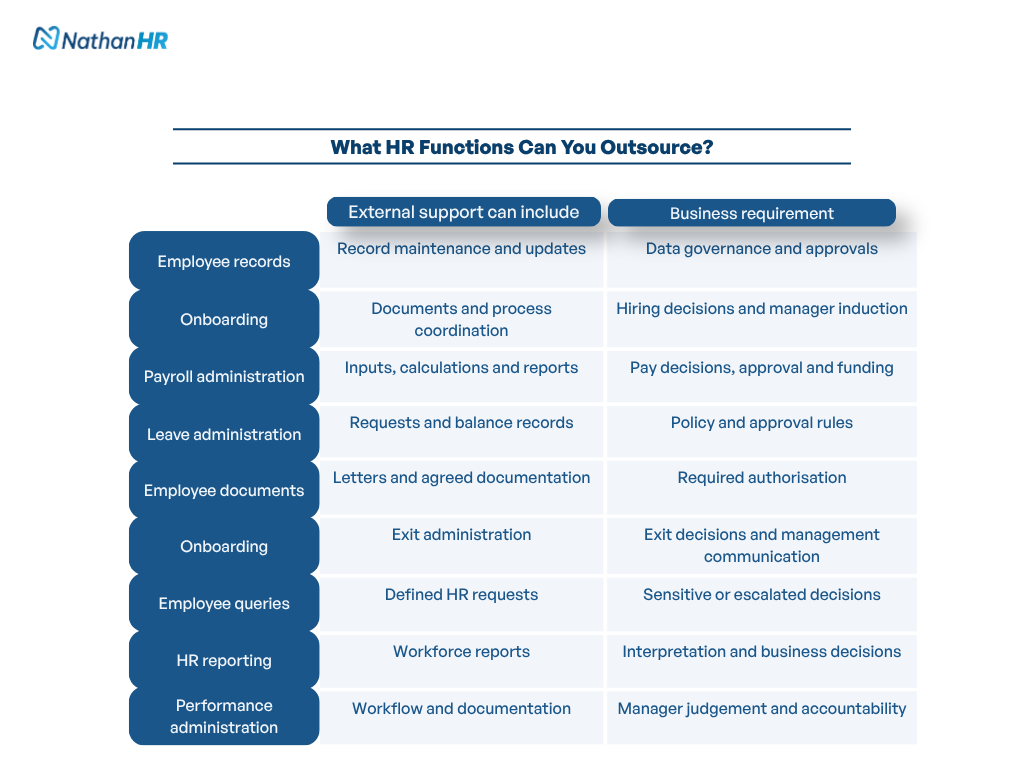
A company with an established HR leader can retain strategic work while transferring recurring administration. A smaller business without a dedicated HR team can use a broader service to introduce structure across routine HR operations.
Full HR Outsourcing vs Partial HR Outsourcing
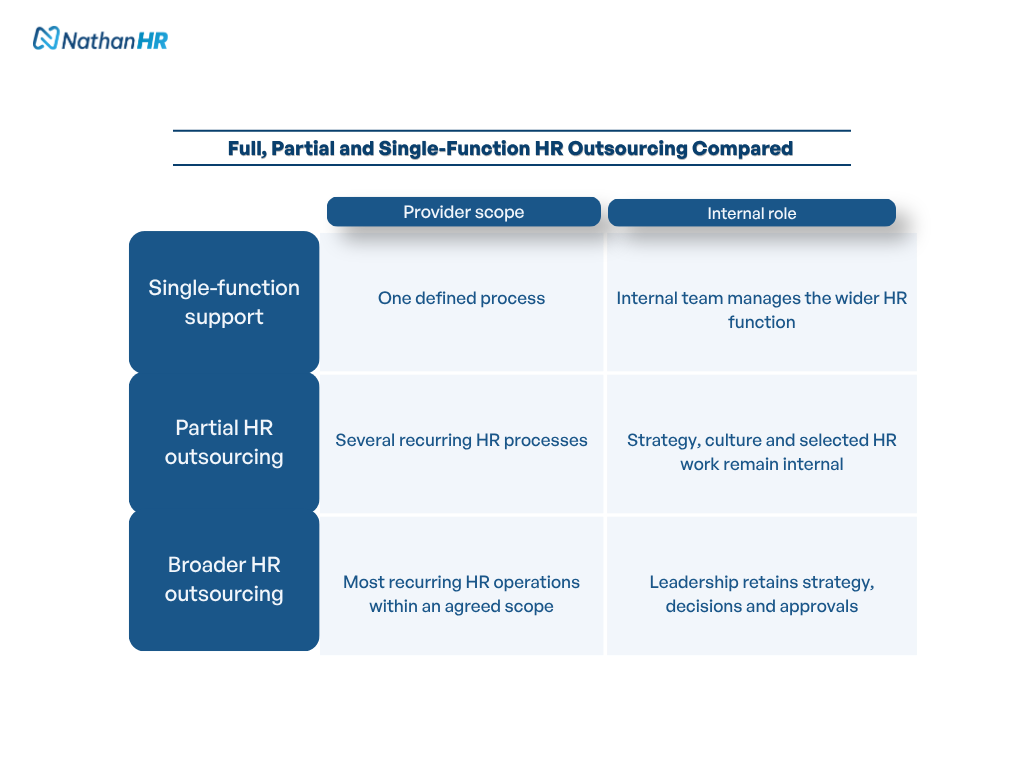
The appropriate model depends on internal capability, workload, headcount and the level of direct HR ownership the business wants to retain.
HR Outsourcing for UAE Free Zone Companies
Free zone companies need to assess HR support against the framework governing their entity.
UAE Government guidance explains that free zone companies operate through their respective authorities, and UAE Government employment guidance notes that free zone employees are subject to the rules and regulations of the relevant free zone authority.
DIFC and ADGM have separate employment frameworks, so companies should not assume that the same HR, employment or government process applies across every UAE jurisdiction.
For a smaller free zone company, HR responsibilities can become distributed across the founder, finance team and office management. As headcount increases, payroll inputs, employee documents, leave records, onboarding and government processes create more administrative work.
A specialist HR provider can establish defined ownership and workflows for the activities included in scope. A free zone company with an internal HR leader can instead use external support for selected operational work.
Wage-payment requirements also require jurisdiction-level review. MOHRE's Wage Protection System governs wage payments for establishments within its scope, while free zone companies should confirm requirements with the authority governing their entity.
Before appointing a provider, confirm:
Which free zones it supports;
Which authority processes are included;
Who handles work permit and residence visa actions;
How wage-payment requirements apply;
How employee records are managed;
How escalations are handled.
Nathan HR's HR outsourcing services page states that its service covers UAE free zones and the mainland.
10 Things Companies Gain from Outsourcing HR
1. Access to broader HR expertise
A business can gain access to professionals across the HR areas included in the service without hiring an internal employee for every discipline.
This can benefit SMEs, growing businesses and lean HR teams that need support across several areas.
2. Less recurring administration
Onboarding, employee documents, payroll inputs, leave records and employee requests create a steady workload.
Transferring defined tasks gives internal teams more capacity for workforce planning, management and business priorities.
3. More consistent processes
Documented workflows, templates and approval points can reduce variation in repeated HR activities.
This can help businesses that have outgrown informal processes or have HR work spread across several departments.
4. Less dependence on one employee
In smaller organisations, payroll knowledge, records or government-process knowledge can sit with one person.
Team-based external delivery can provide documented processes and backup capacity when that employee is absent or leaves.
5. Capacity that grows with headcount
Every additional employee creates onboarding, payroll, leave, record-keeping and eventual offboarding work.
An external service scope can expand as workload increases without requiring a new internal HR role at every stage of growth.
6. Stronger process controls
Payroll and HR administration rely on accurate inputs, approvals, deadlines and records.
Defined checkpoints and ownership can strengthen process discipline. External support does not guarantee error-free payroll or legal compliance.
7. Better organised employee information
A structured HR service can bring agreed records and reporting into consistent workflows or technology.
That gives management a stronger foundation for workforce administration and reporting.
8. Access to established HR systems and workflows
Some HR service models include technology for employee records, requests, payroll, onboarding or reporting.
Businesses should still assess data protection, access rights, record ownership and arrangements for transferring information if the service ends.
9. Additional capacity during growth or organisational change
Hiring programmes, restructuring and HR projects can create periods of heavier workload.
External support can add delivery capacity for the activities included in scope without requiring permanent internal recruitment for a temporary increase in work.
10. Less need to build every HR capability internally
An in-house HR model can require employees, systems, training, specialist knowledge and continuity planning.
External support gives a company the option to combine internal leadership with specialist operational delivery where that structure suits the organisation.
Outsourced HR vs In-House HR
Neither approach offers the strongest fit for every organisation.
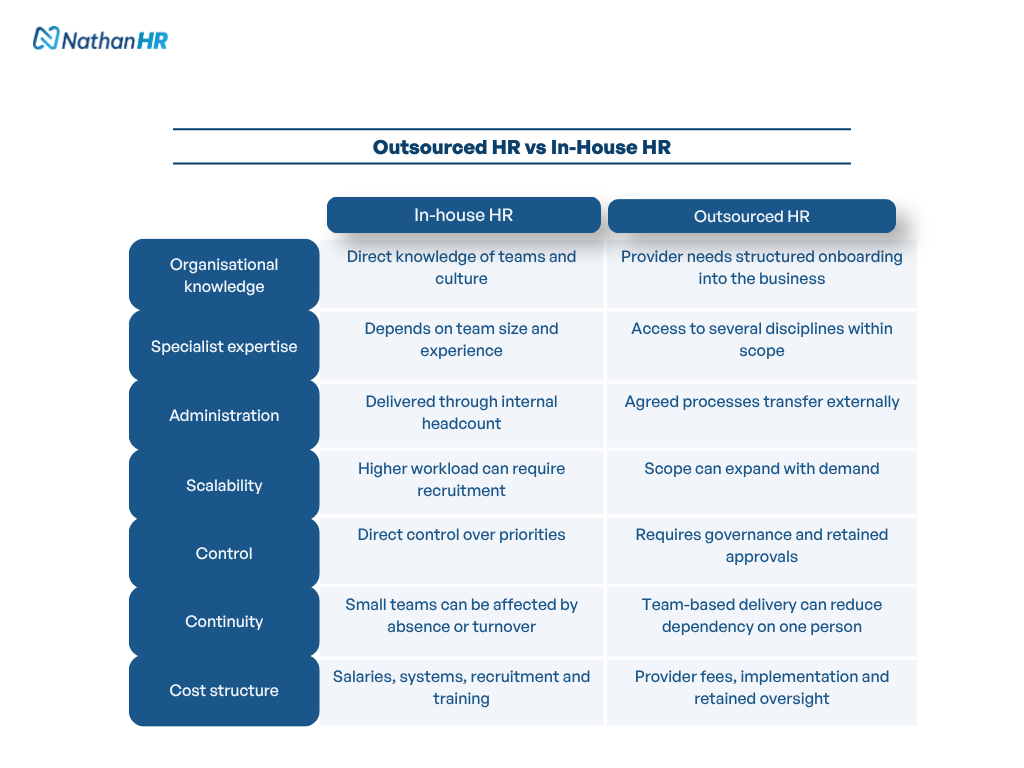
For companies assessing the wider decision, Nathan HR also provides a guide to when HR outsourcing fits a UAE business.
What Affects HR Outsourcing Cost in the UAE?
Pricing depends on the scope and complexity of the service.
Factors can include headcount, number of HR functions, legal entities, jurisdictions, payroll requirements, technology, reporting, implementation and project work.
Compare proposals against a detailed service schedule. Confirm what is included, what falls outside the agreed scope and how pricing changes with headcount or service requirements.
How to Choose an HR Outsourcing Company in the UAE
Before appointing a provider, ask:
Which HR functions are included;
Which responsibilities remain with your company;
Which mainland and free zone jurisdictions it supports;
Who manages the relationship;
How employees contact the HR team;
What technology and data-protection controls are used;
What reporting and service commitments apply;
What is included in the fee;
How escalations are handled;
How records and responsibilities are transferred when the service ends.
The service agreement should document ownership, approvals and processes for work outside the agreed scope.
How Nathan HR Supports Outsourced HR Operations
We provide HR outsourcing services in the UAE for companies seeking support across all or part of their HR operation.
Our current service scope can include employee administration, payroll and WPS support, onboarding and offboarding, visas, work permits and government transactions, employee requests, HR advisory support and HR technology, depending on the agreed client scope.
Businesses seeking dedicated payroll support can explore our payroll outsourcing services. Companies considering a different legal employment structure can review our Employer of Record services.
Talk to Nathan HR About Your HR Structure
If you are deciding which HR functions to keep internally and which to transfer, speak with our team about your headcount, entities, jurisdictions and current processes.
We can discuss the areas where you need support and define an HR outsourcing scope alongside the responsibilities your leadership team will retain.